Creature Comforts

It started last November with all the ingredients for my favourite kind of morning – London, an artisan café, autumnal weather, and most important of all, excellent company. On this occasion, Mike’s oldest schoolfriend from Cape Town, and his wife Gaby, who were over on a visit to their daughter. I’ve got to know them well on recent trips to South Africa and it was a joy to see them.

‘We’ve got a booking for the Kalahari,’ they said as we drank our coffee and divided up the cake. ‘In March. We’ll be away for three weeks. It’s a two day drive from Cape Town at either end and the rest of the time we’ll be camping in the desert. Do you fancy joining us?’ Mike’s face lit up. One of the world’s great wildernesses, rich in wildlife and hardly touched by humans. He’s often said wistfully that he would love to see it. None of us doubted what his response would be but he, ever considerate, held back. So all eyes turned to me and I, with my profound dislike of hot weather, terror of snakes and spiders, and no experience of roughing it in the wild, found myself saying ‘That would be really lovely. Thank you.’ Mike looked over the moon. And a little surprised. ‘We’ll get you a special UV torch,’ said Andries, ‘For night-time. So you don’t tread on any scorpions,’ he added comfortingly.

Three months and several Zoom calls later, we arrived in Cape Town. We were armed with a bag of books, powerful binocs and Mike’s new telephoto lens, and over the next few days we shopped for light clothing and enough provisions for the entire trip. Most of the desert camps have a shop but they’re so remote that they carry only basic stock. On Friday evening our friends packed their 4×4 and trailer with mathematical precision. They’ve had countless African adventures and know exactly how they want things done but as I stood around trying to be useful, I came up against the first challenge of the holiday. I remembered how much I hate feeling like a spare part, not knowing what to do.

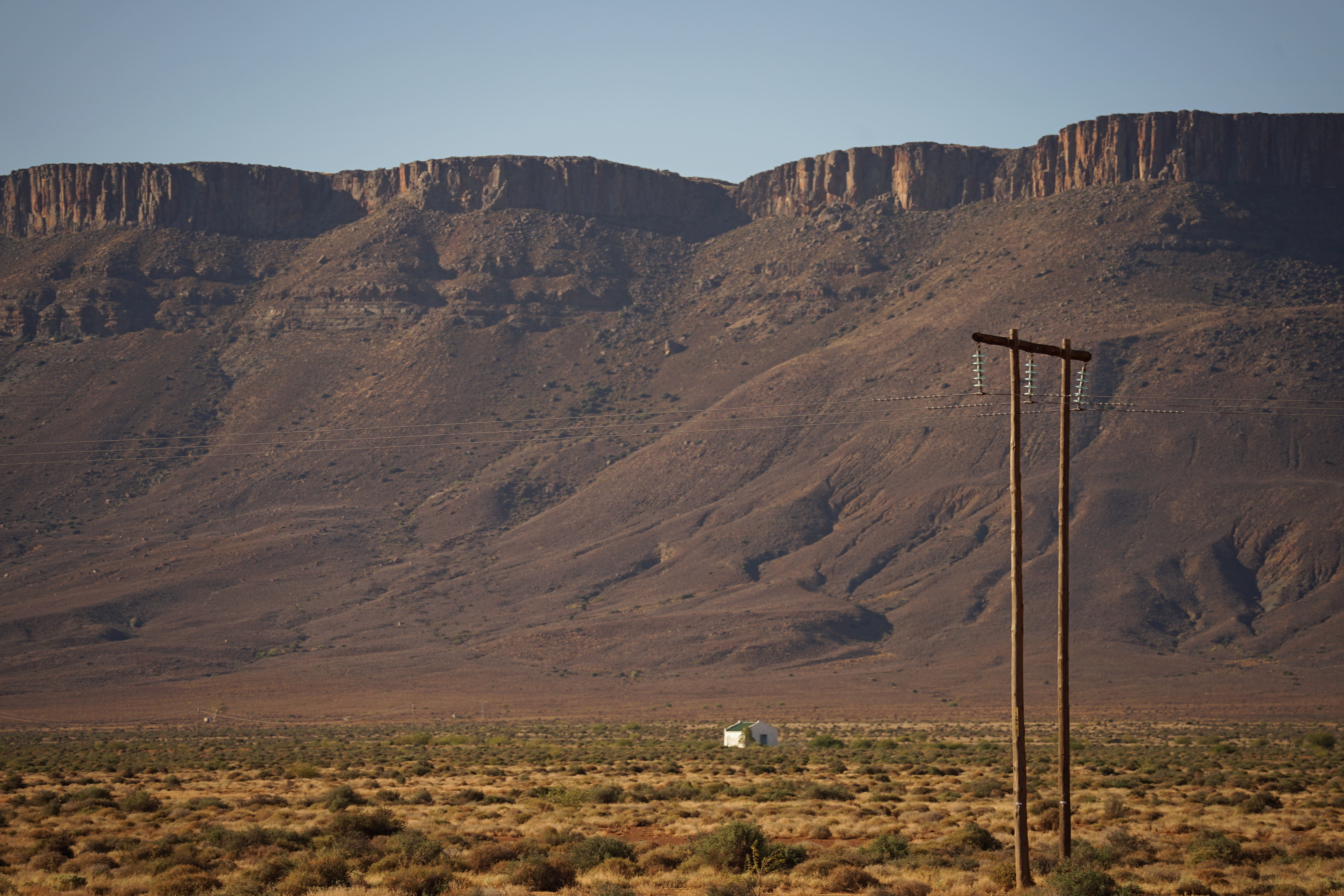
We set off on Saturday morning and by Sunday afternoon we had crossed stupendous mountain passes and driven across hundreds of kilometres of valleys and plains dotted with orange and grape farms, leggy ostriches and occasional small towns. We shopped at Upington, the nearest big town to the Kalahari, to top up on perishable fruit and veg, and by now I was attempting to refer to our destination as the Kgalagadi which is the term used by the Tswana people, and the preferred name in post-apartheid South Africa. I was hampered though by my English reserve, which was making it tricky to produce the phlegmy, throat-clearing sound required for authenticity.
About three hours and over two hundred kilometres out of Upington we were rolling along, chatting easily about this and that, and AI, and modern Shakespeare, when a young chestnut horse cantered out of the deep undergrowth and straight into our path. Time slowed down and I remember us all screaming as there was a loud bang, and the horse bounced sideways, then rolled into the road beside us.

For a minute or two, it lay there, surely dying, as we stared in horror, absorbing what had just happened and wondering what to do here, in the middle of nowhere. Then slowly, the horse got up and ambled off, stopping by the side of the road to nibble some grass. As for us, our radiator grille was caved in and the bonnet severely buckled. There was no way we could carry on.

By pure luck on such a quiet road, two locals came past at that moment and stopped, offering kind words and calling the police. Ten minutes later the duty officer turned up in Sunday shorts and flip-flops with his four children in the back of the car. ‘This often happens here,’ he told us. ‘You were v-e-ry lucky,’ emphasising very — drawing it out in an African lilt. ‘On Friday, a man and a horse died here. If you’d been going faster… We learned later that these horses are not wild but the owners do not want the expense of fencing. Nor do they want to admit liability for accidents.

‘The best thing you can do is to go to the lodge up the road, stay there the night and sort things out in the morning, ‘ advised the policeman. So, processing very gingerly — fortunately the radiator wasn’t leaking but there was a loud clanking sound — and accompanied solicitously by all of our new friends, including the children, we rattled our way to a smart, thatched lodge hotel with manicured grounds, palm trees, a turquoise swimming pool, and a small camping area. Hot, exhausted and dispirited, we dredged up the energy to pitch our tents and to prepare a meal, all the time aware that things could have been much, much worse.

Andries spent most of the next day on the phone to his insurance broker, repair garages, recovery services, and every car hire company in the area. Things were complicated by our remote location and the dearth of 4x4s with a tow bar but he stayed admirably calm and by 4pm a suitable vehicle had been driven up from Upington and delivered to us. We took down the tents, folded up our chairs and tables, emptied the original car and packed everything into the new one. Our friends said a sad farewell to their beloved car, which would later be assessed by the insurers as not worth the cost of repairs, and we set off for the Kgalagadi Transfrontier Park which is roughly the size of Switzerland, incorporates part of Botswana to the east, and borders Namibia to the west.

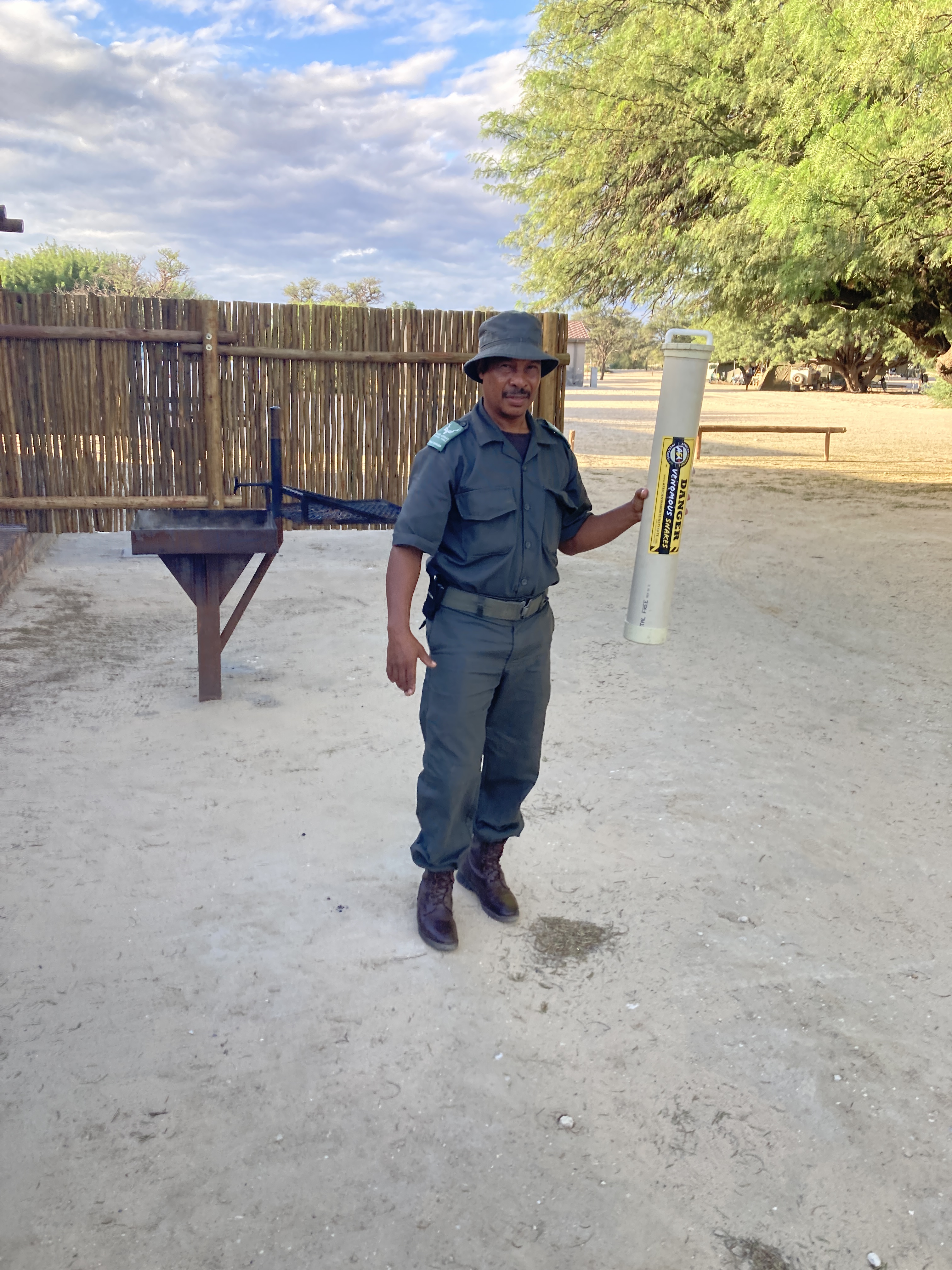
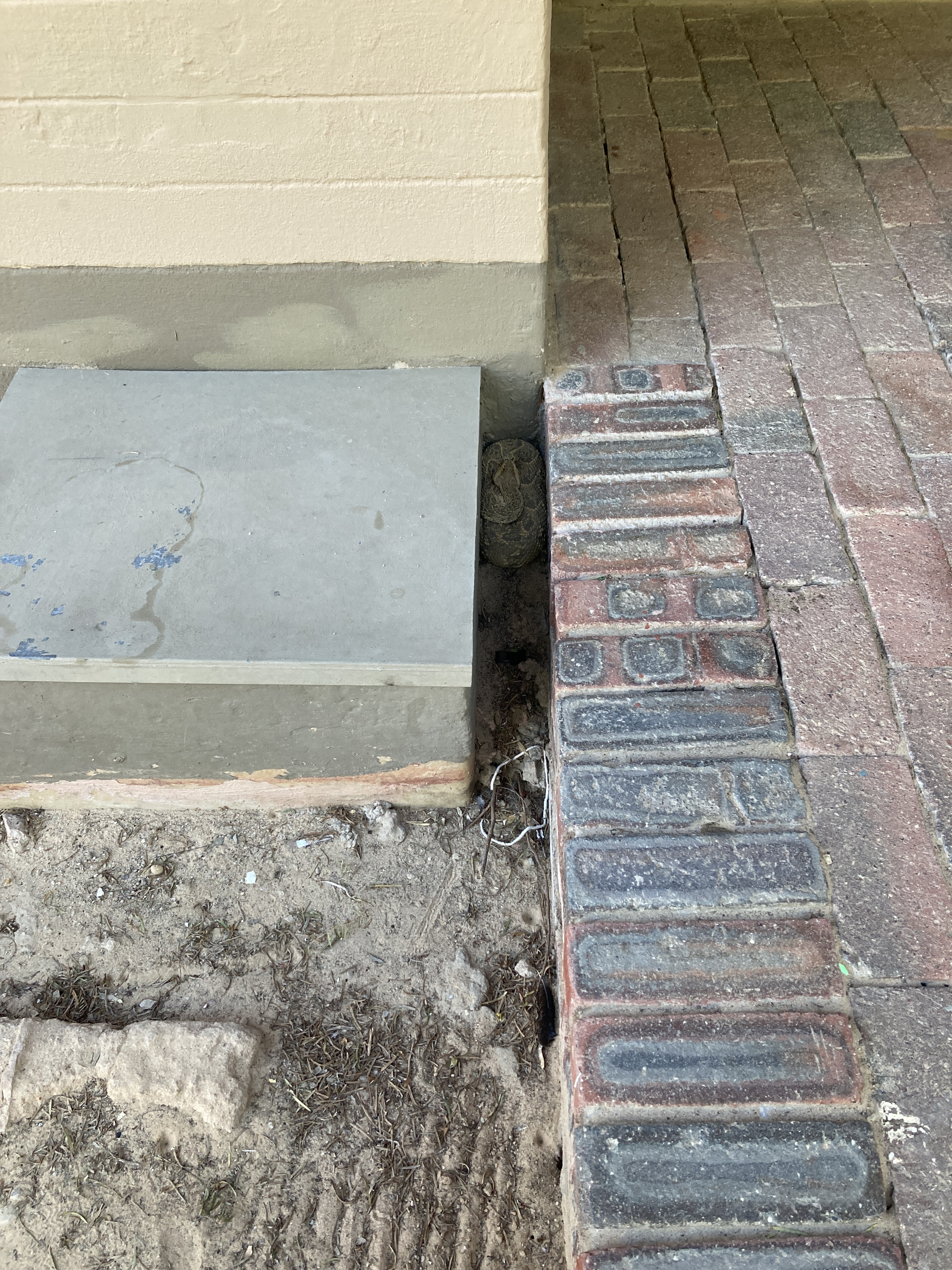
Our first camp was on the Botswana border, and we slept very well but woke up the next morning to find several uniformed staff examining the ground around our tent with forensic care. ‘A puff adder, ‘ said one, pointing to a clear trail in the sand. ‘Look, it went right past your tent.’ ‘Do they bite?’ I asked. Serious nods. ‘H-i-gh-ly venomous. But don’t worry. We’ll find it.’ And they did. Half an hour later, a ranger beckoned me over, and pointed at a zig-zag-patterned snake curled up in a gap next to a concrete step. The snake-catcher was summoned and used a long grabbing device to guide the animal into a plastic carrying tube but not without a fair bit of cautious jumping about and shouting from other park staff as the snake vigorously objected to being disturbed. Once in the tube it was driven off to be released at least twelve kilometres away.
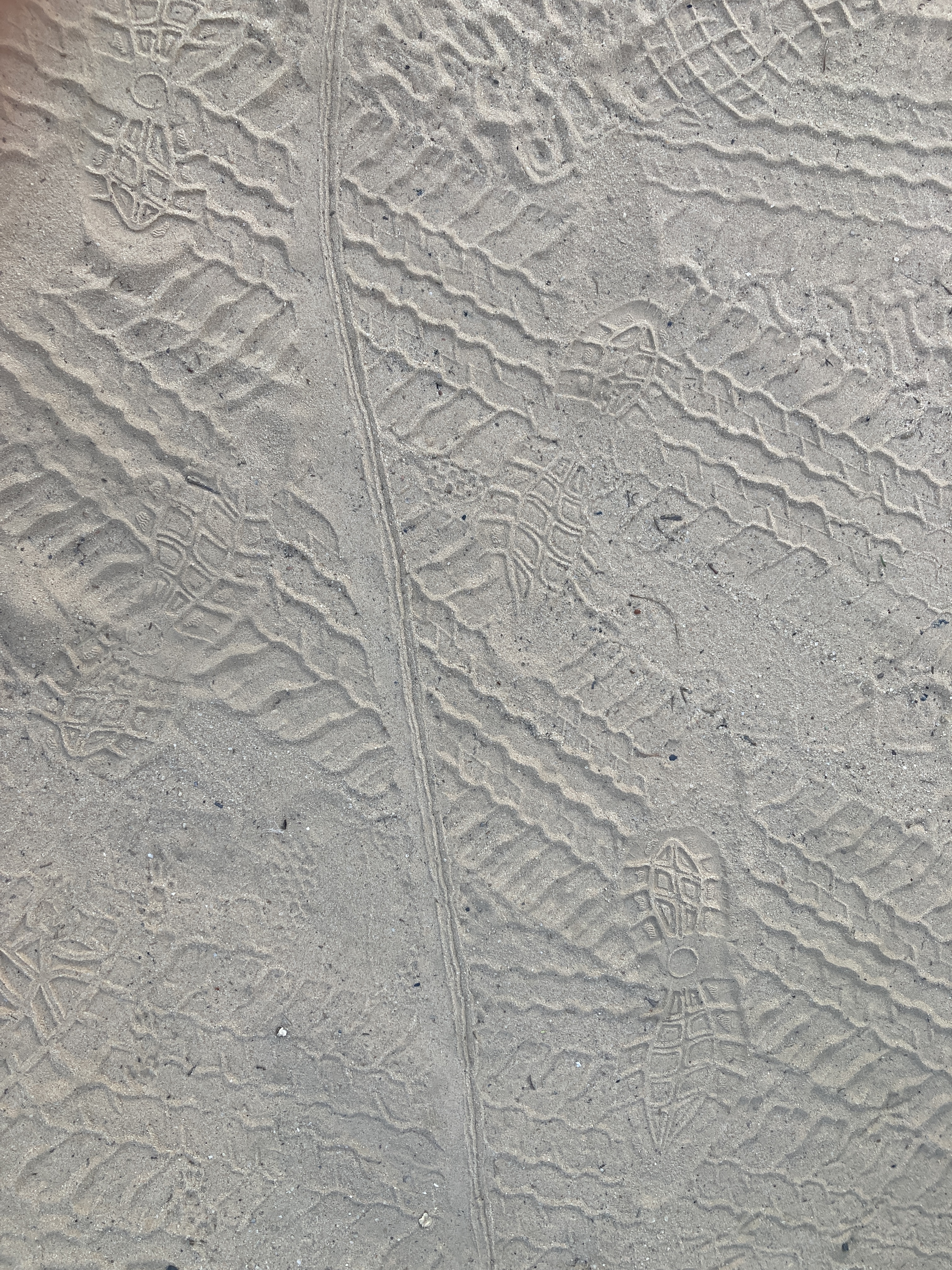
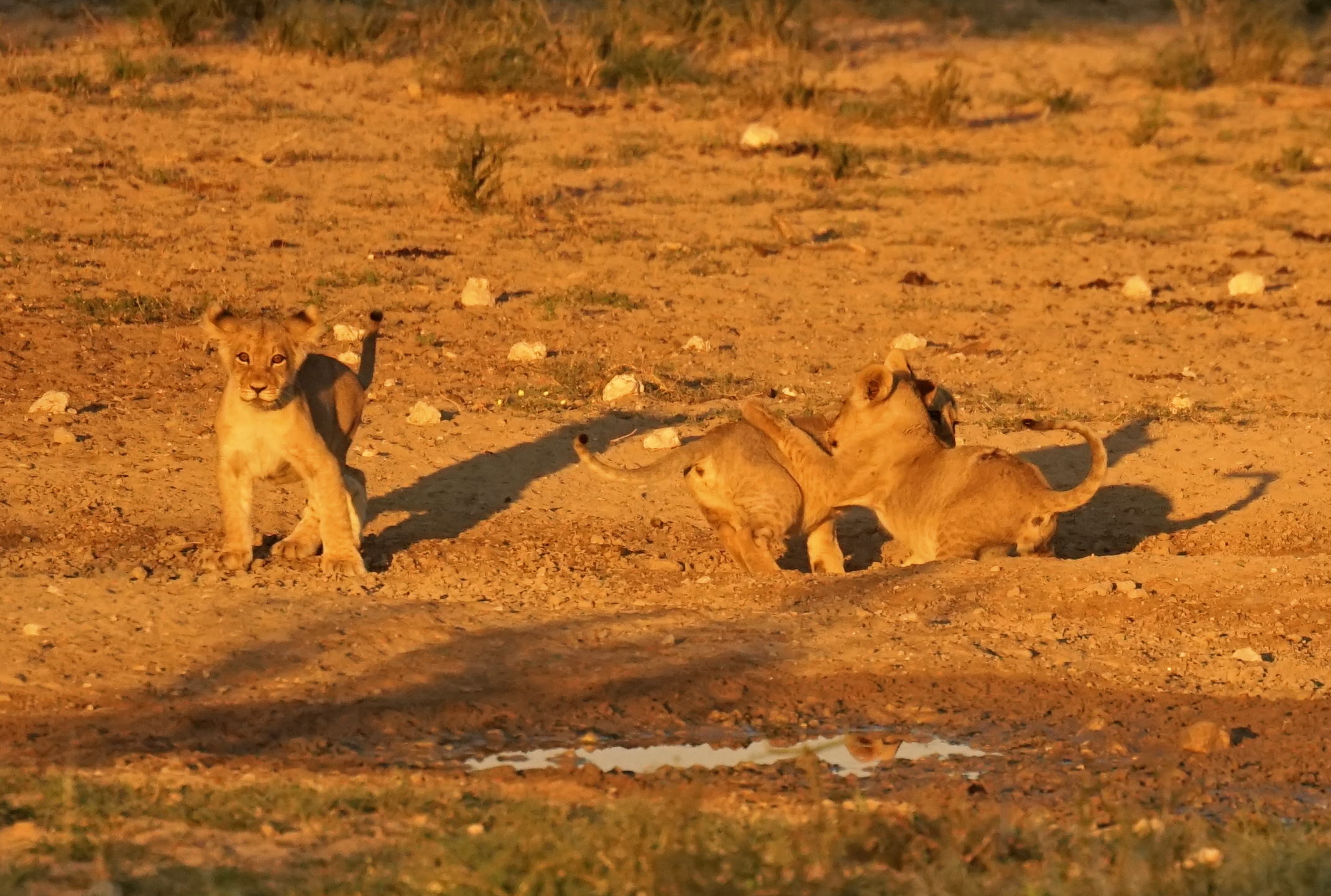
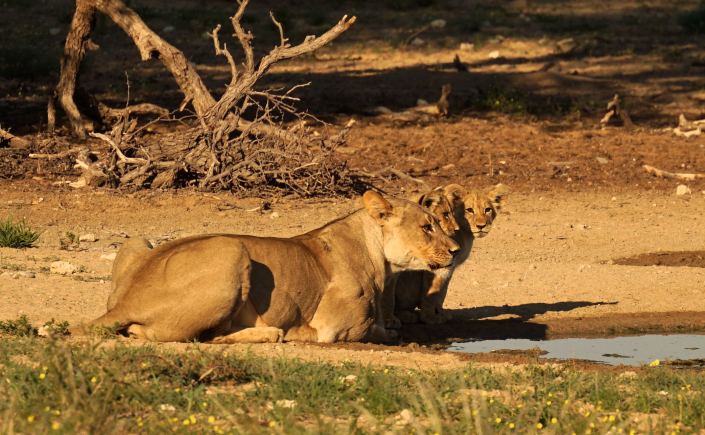
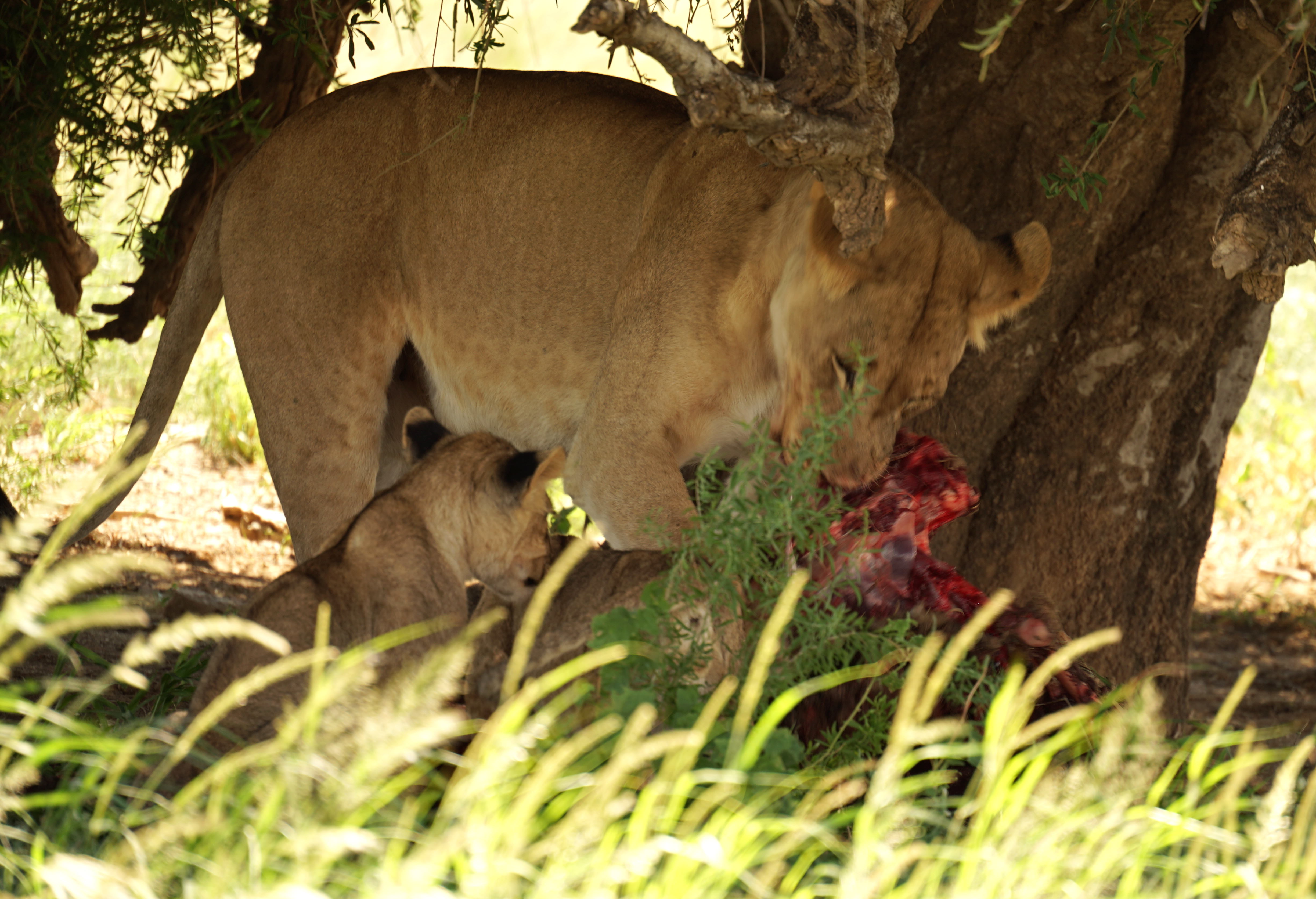
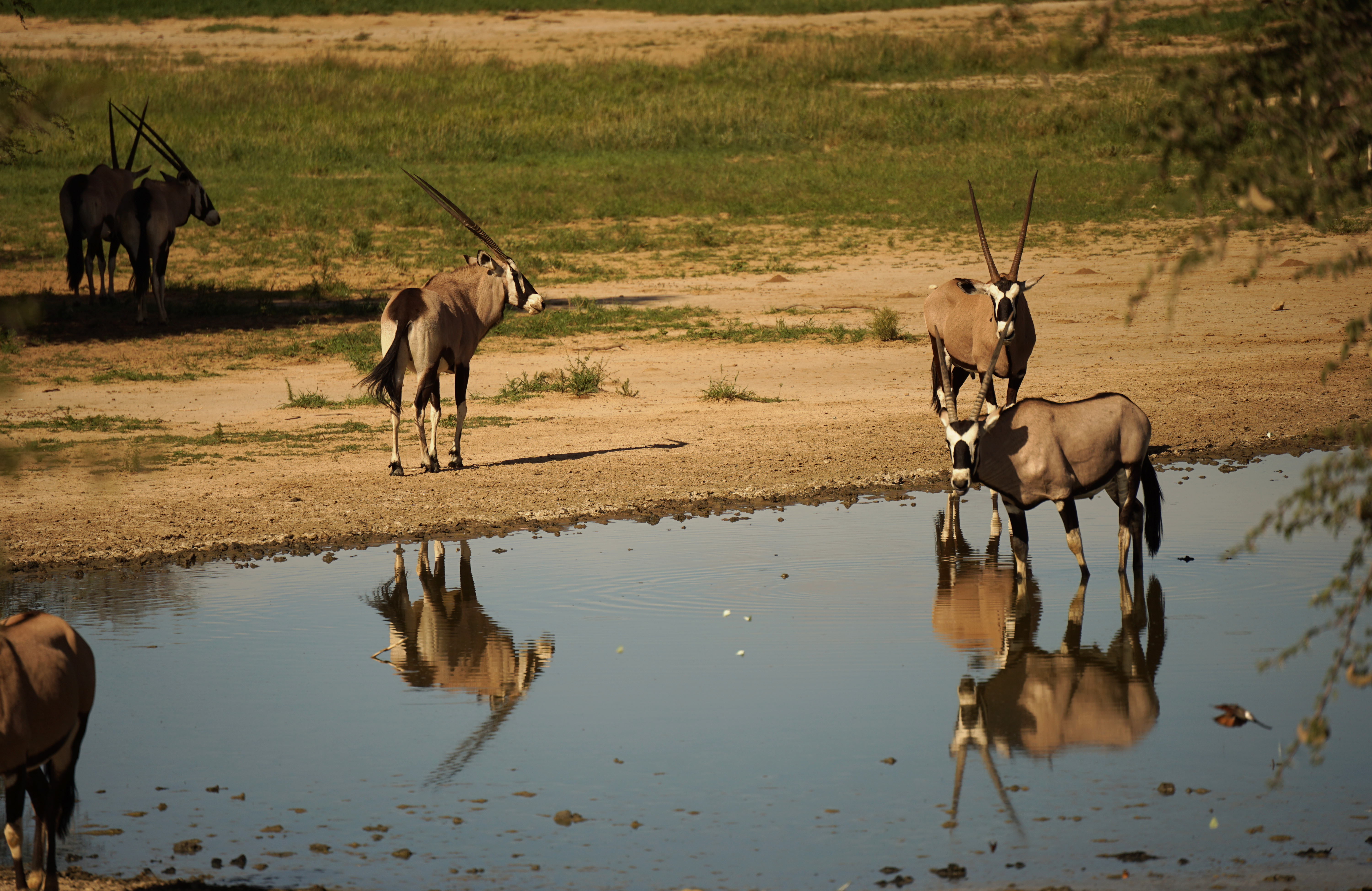
The Kgalagadi sand makes it particularly easy to spot animal tracks. That’s an invaluable way of identifying which animals are nearby and later that day we made use of a different type of clue — animal behaviour. We pulled up next to a waterhole as two red hartebeest came trotting along. It was a hot day and they were clearly looking forward to a cool drink but suddenly they stopped, stood stock still, and made off in the opposite direction. Something had upset them and then we spotted two lionesses in the shade of a tree. They were tearing at a fresh kill — probably another hartebeest — and with them were three cuddly-looking cubs who were tucking into the feast with equal enthusiasm. A jackal hovered nearby, warily awaiting its turn, and vultures circled above.
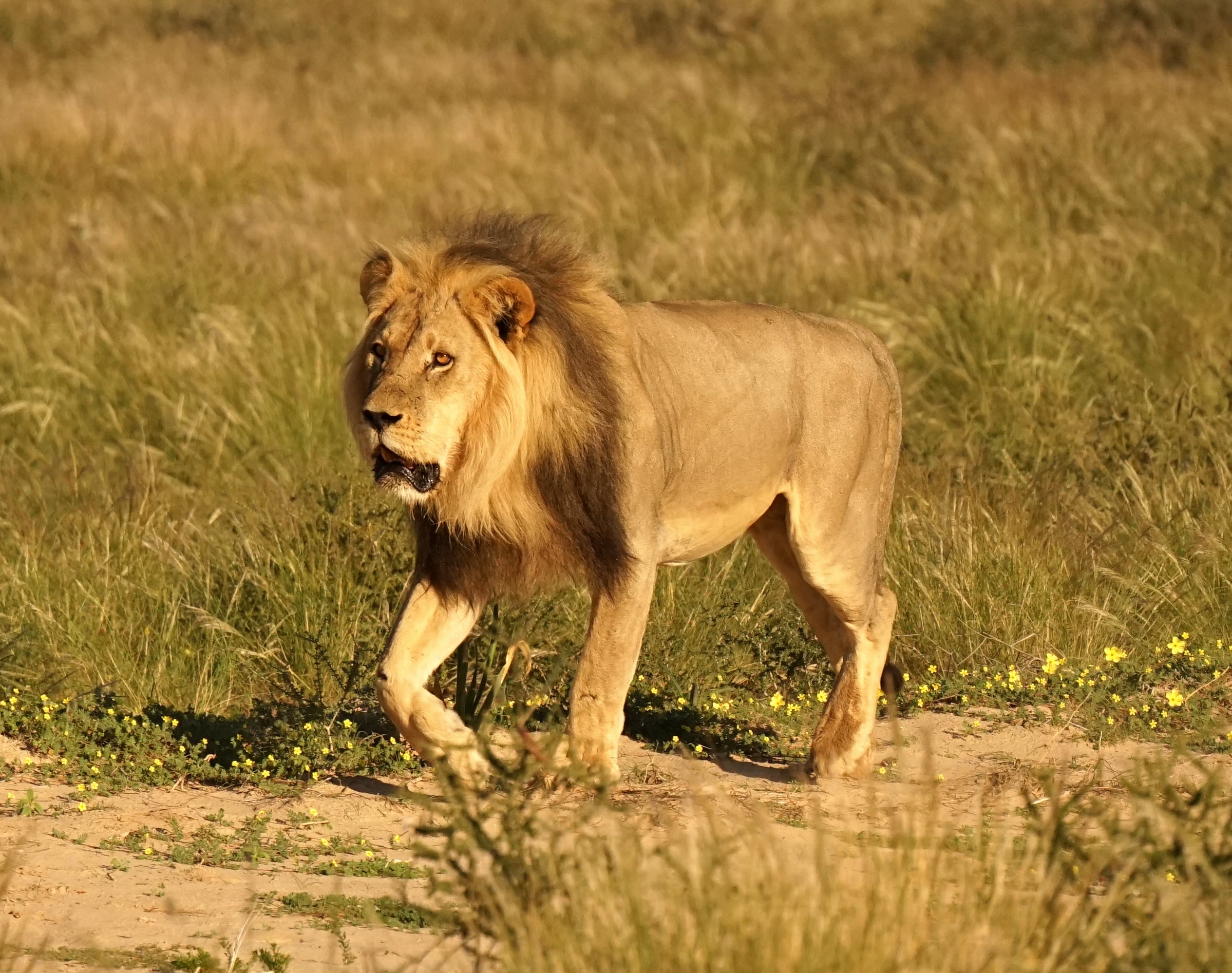
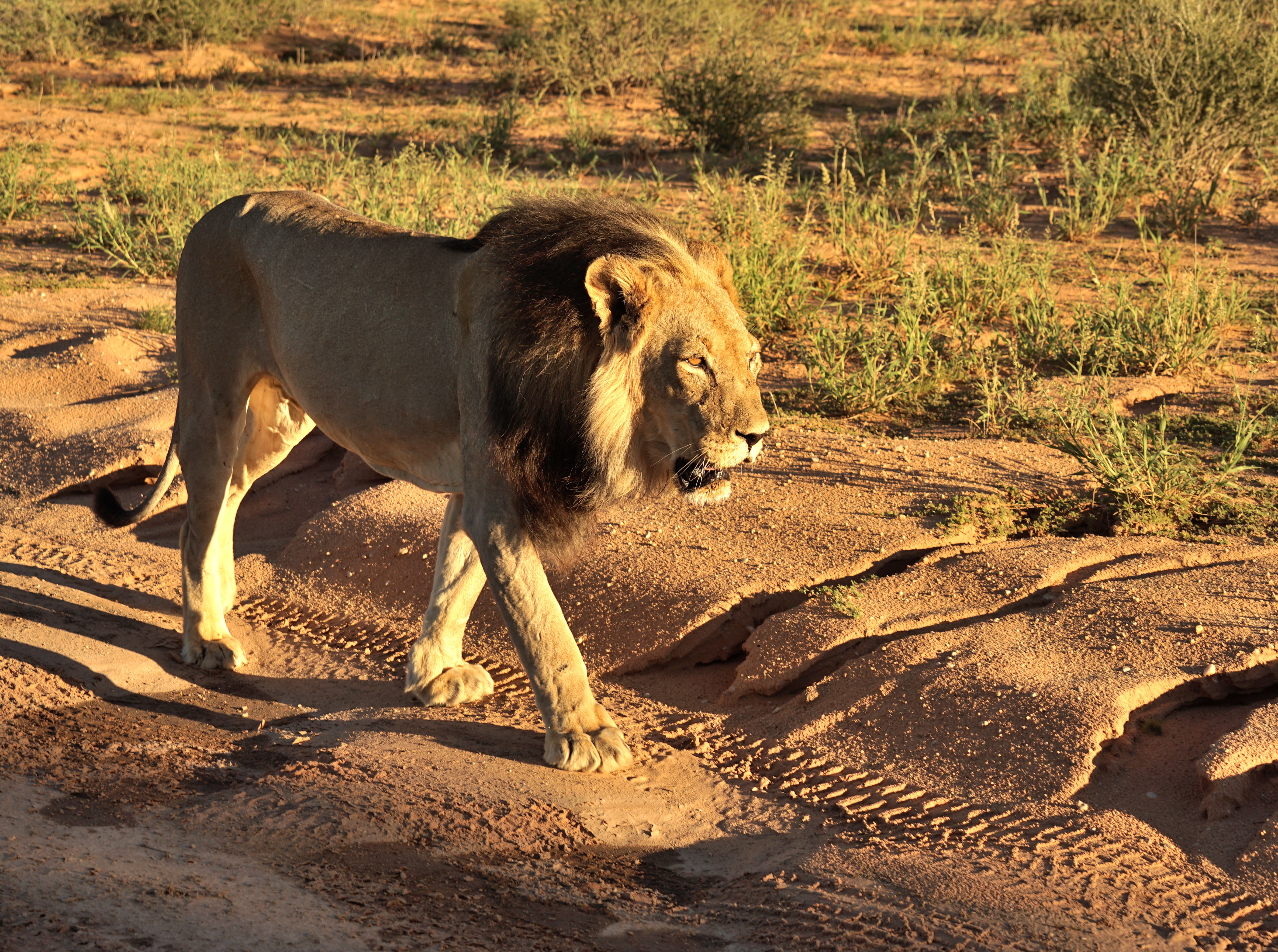
That evening we came across a male lion, possibly from the same pride and we stopped the car and watched as he plodded regally along the road towards us, stopping now and then to mark his territory with a great shower of urine. As he walked past my window I looked into his yellow eyes. He was entirely indifferent but for me it was a moment of pure magic.
Today, nearly two weeks later, I’m writing this on the verandah of our penultimate stop. We’ve pitched our tents and set up our kitchen six times now and since I know better what to do, I’m feeling much less like a spare part. Instead of finding these in-between bits tedious and longing to get them over as quickly as possible, I’m close to enjoying the process. Taking down the tents on moving days, packing up the trailer, then doing it all again at the opposite end of the day. Washing up in the communal scullery and chatting with other campers from all over South Africa and Europe. Swapping tips and stories of what we’ve seen. Some are only interested in the big cats, hunting them down with huge telephoto lenses. Others talk enthusiastically about the great eagles, the silent swooping owls, and the clouds of yellow canaries.

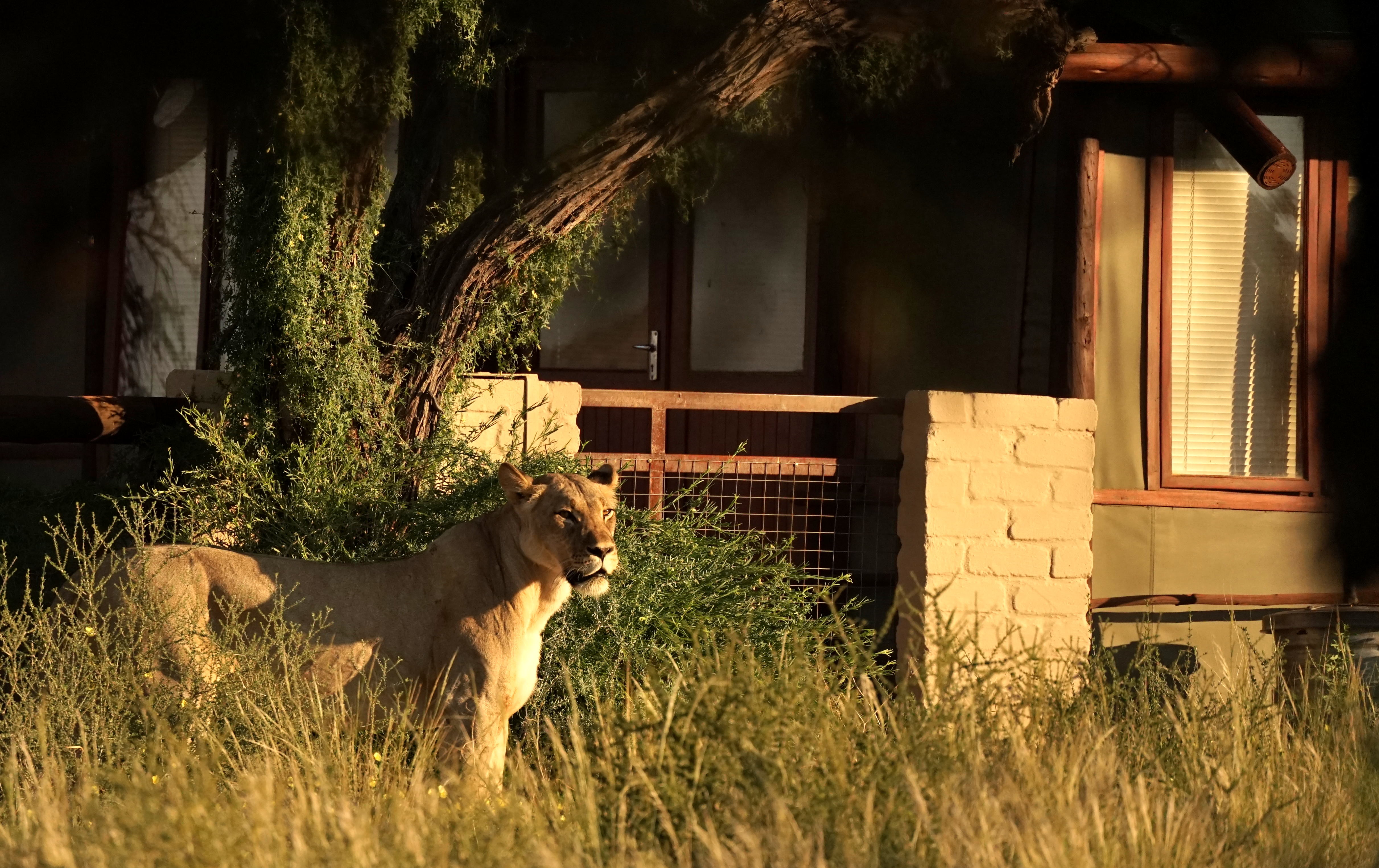
This four-day stop is our reward at the end of some very long drives, hard work and discomfort. We are at one of the smallest, most remote wilderness camps. There is one warden and four chalets for visitors. They are simply constructed from sandbags and canvas but with proper beds and linen, our own bathroom and a small outdoor kitchen. Best of all, we are very close to a waterhole with just a four-foot high fence between us and the animals. We are supplied with whistles which we can use to summon the warden but really there is nothing but common sense to keep us safe. A previous resident did not heed the warden’s instructions to shut their front door, and found a Cape cobra in the bathroom. They might equally well have found a lion curled up on the bed. There is great demand for these chalets and our friends were thrilled to get this booking. It’s certainly a special place.

The others have gone out for a drive today but I want to sit and think about what I’ve seen. I’ve got a striped tree mouse and a couple of black lizards for company, darting about in the sun, and I know there are pale-green geckos sleeping in cracks in the walls. They come out at night, scurrying around in the kitchen and sticking themselves to the outside of the windows where they give masterclasses in moth-hunting. Creep close. Lurk like a statue. Dart. Gulp.

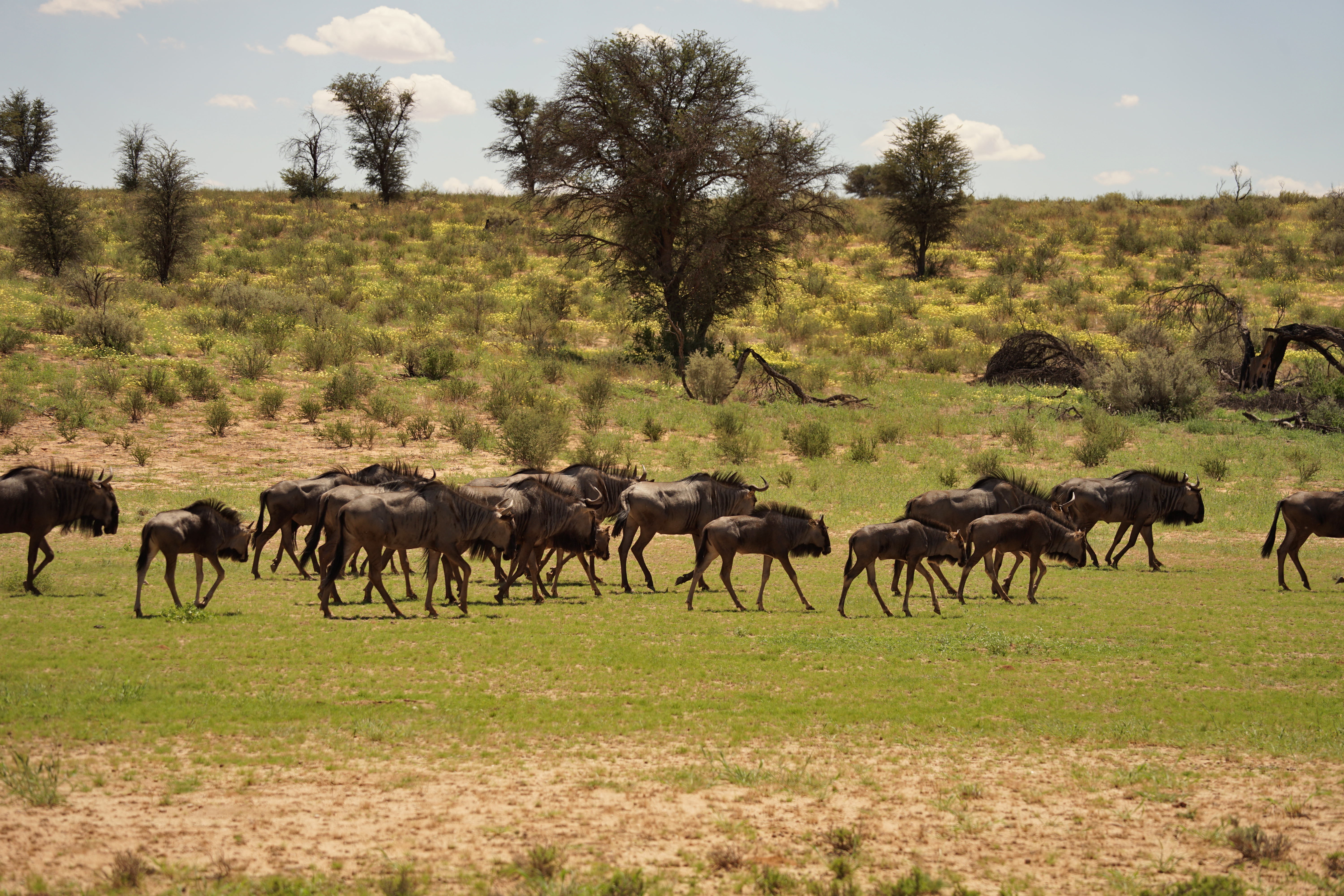
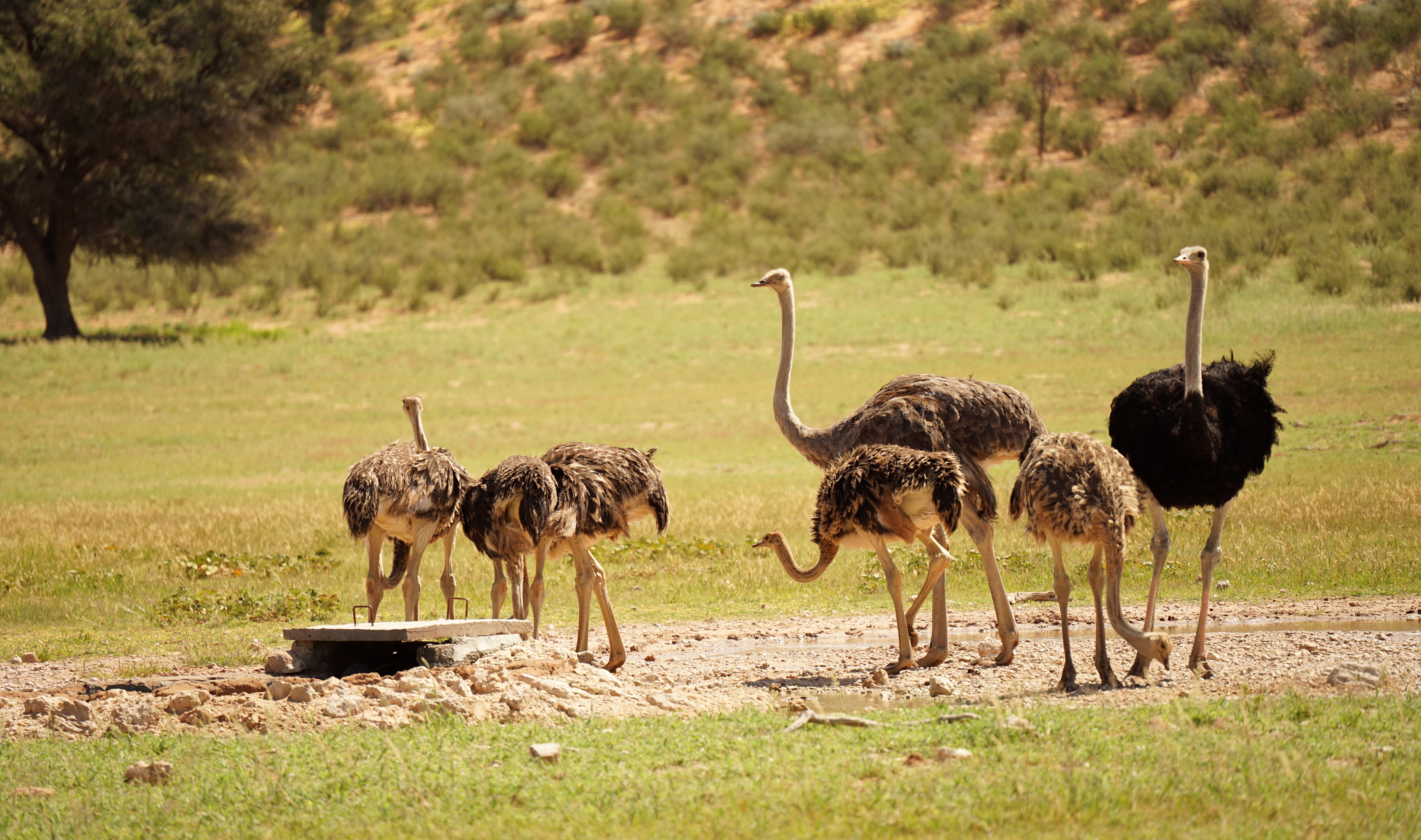
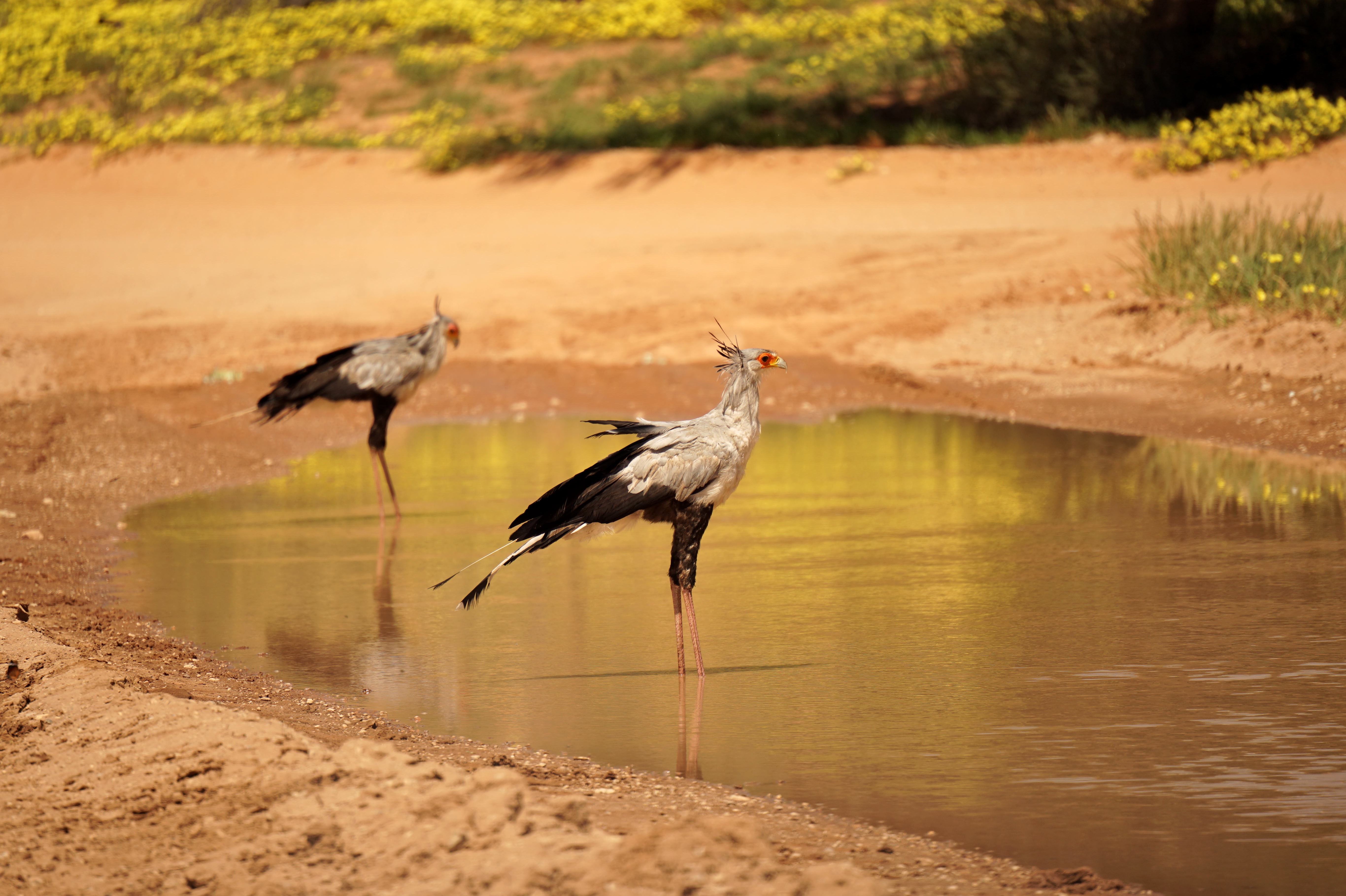
Whenever I look up there’s a different combination of animals at the waterhole. Some balletic ostrich parents with a clutch of teenagers, then a couple of secretary birds dunking their heads for a drink before setting off in a perfect illustration of their collective noun — a stride of secretary birds. Long-paced and intent. Next two wildebeest, and then a herd of them. Several days ago we saw a similar herd chasing around in big circles on the plain. On first sight they looked completely crazy but as we watched more closely, we decided that they were training the young ones to make the handbrake turns that confuse their predators.
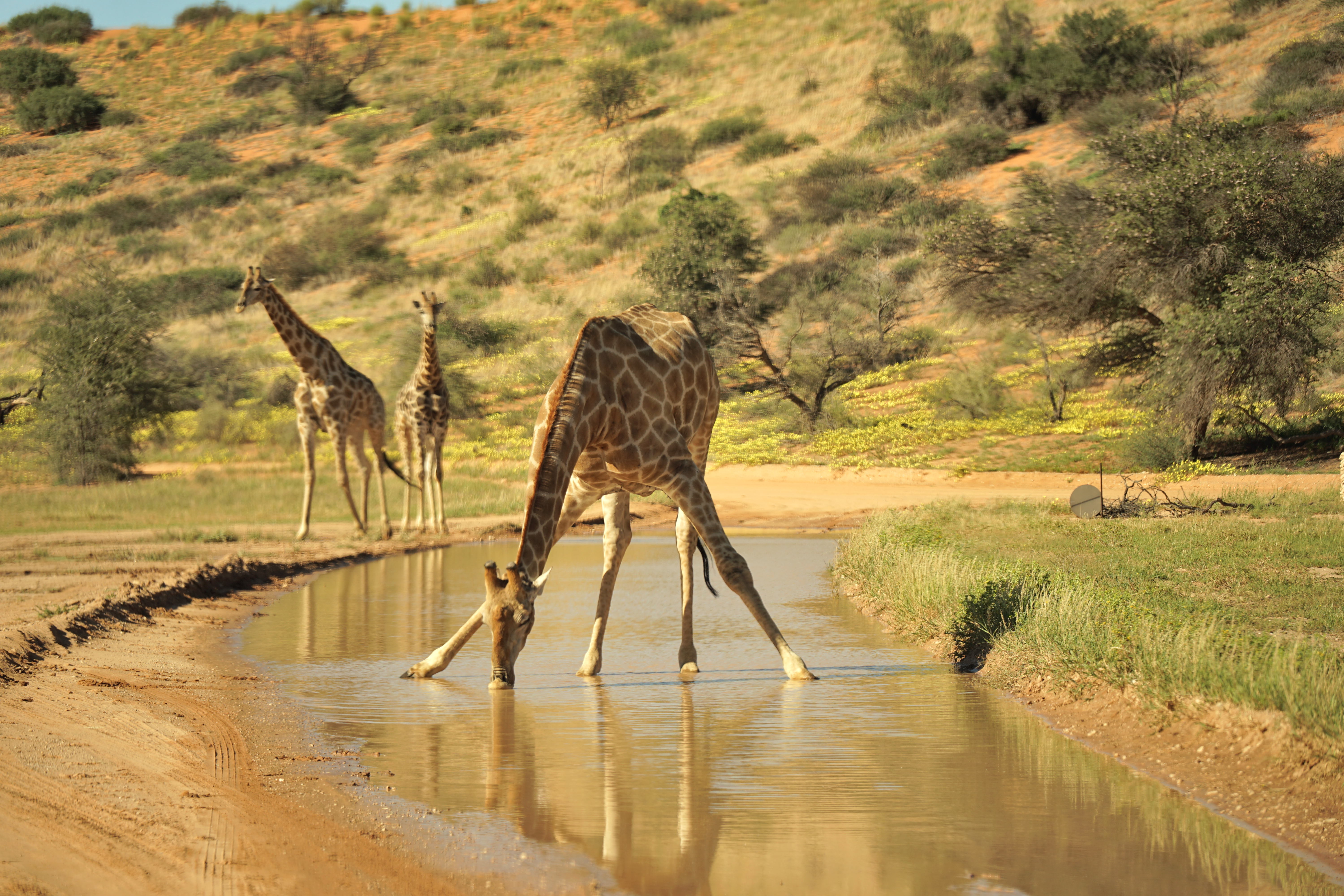
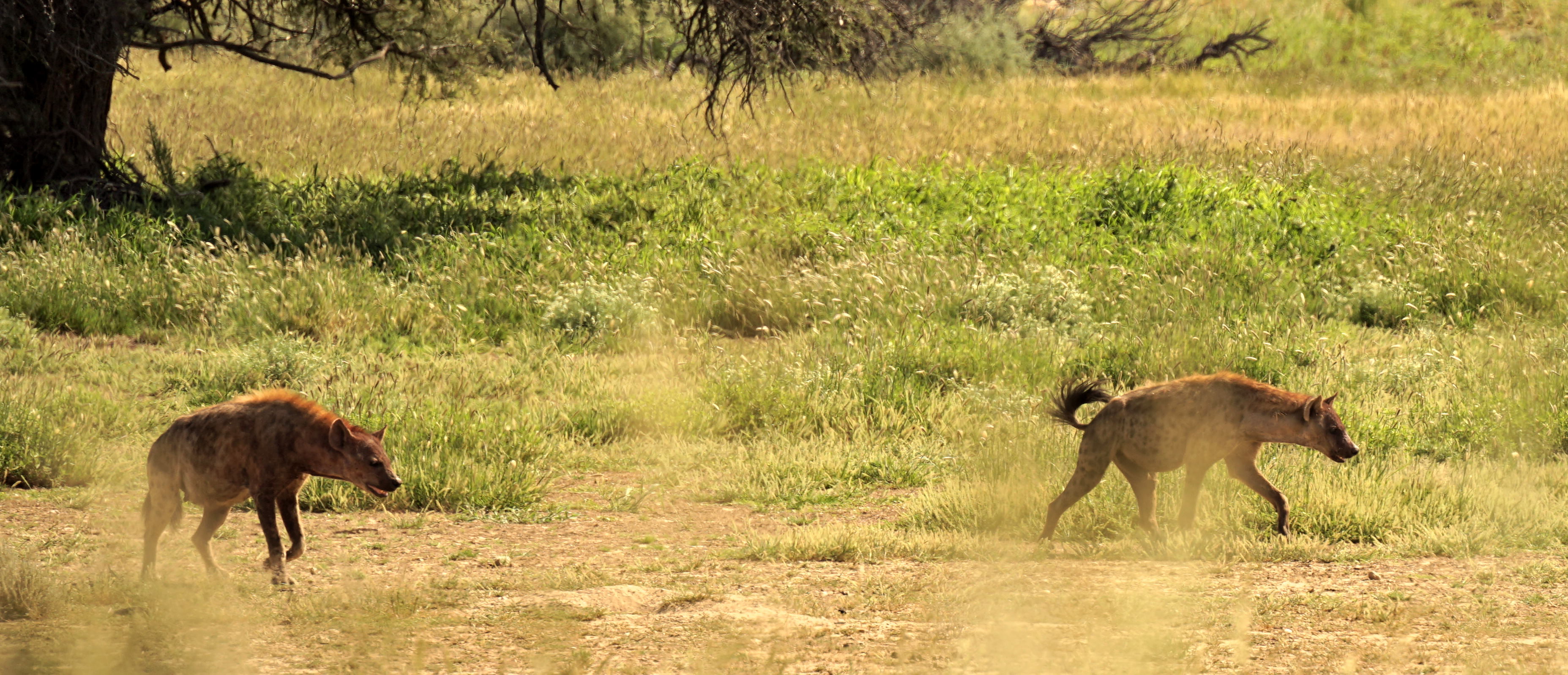
No giraffes yet but we’ve seen plenty on other days, managing to look both elegant and ungainly as they splay their legs and bend to drink. Every animal is beautiful in its own way. Spotted hyenas are often described as ugly but it was a thrill to see a pair marching across the plain. Thuggish and sinister, it is the females who are the most intelligent and lead the pack. They have the strongest jaws of all the predators and a pack working together is capable of killing a lion.
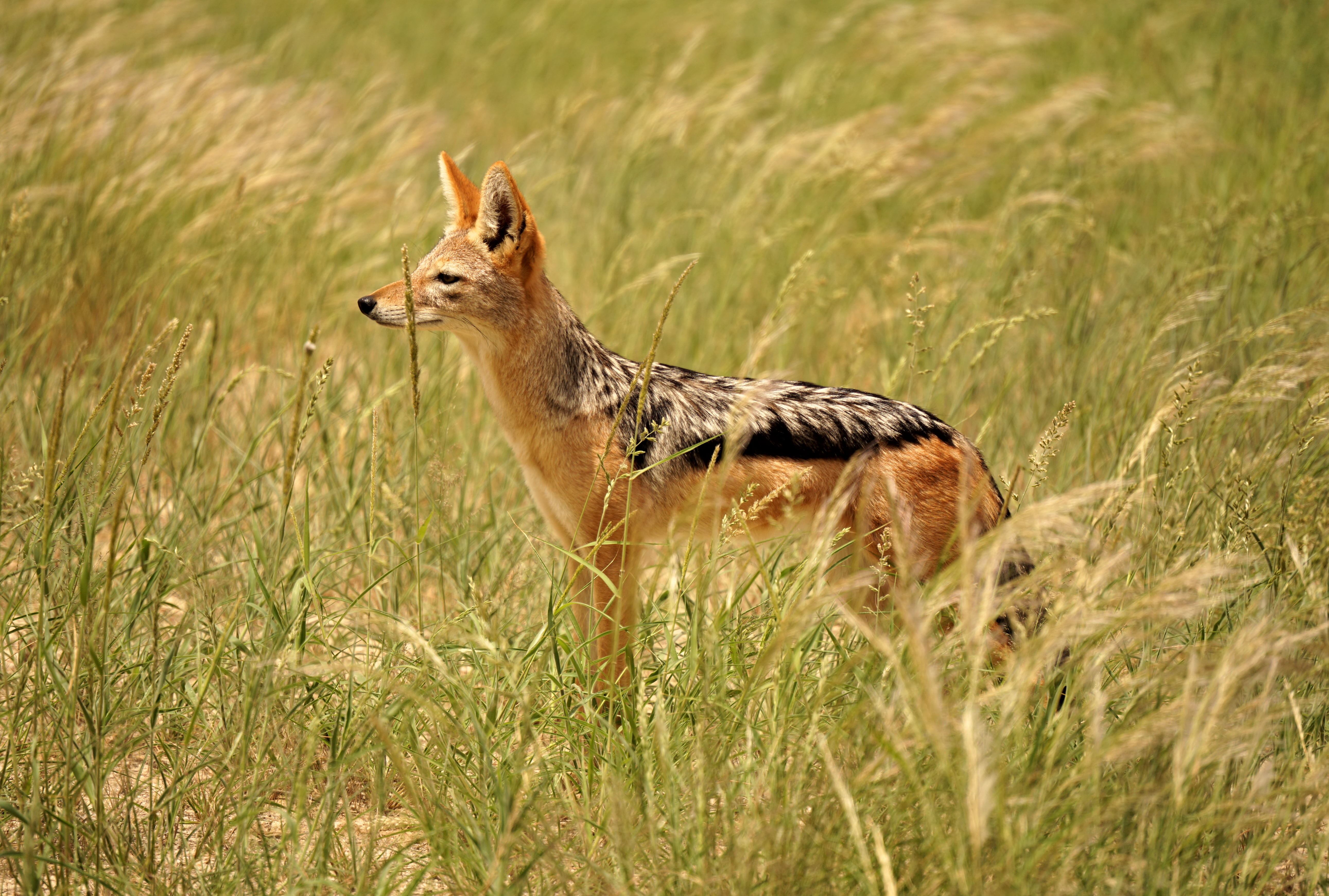
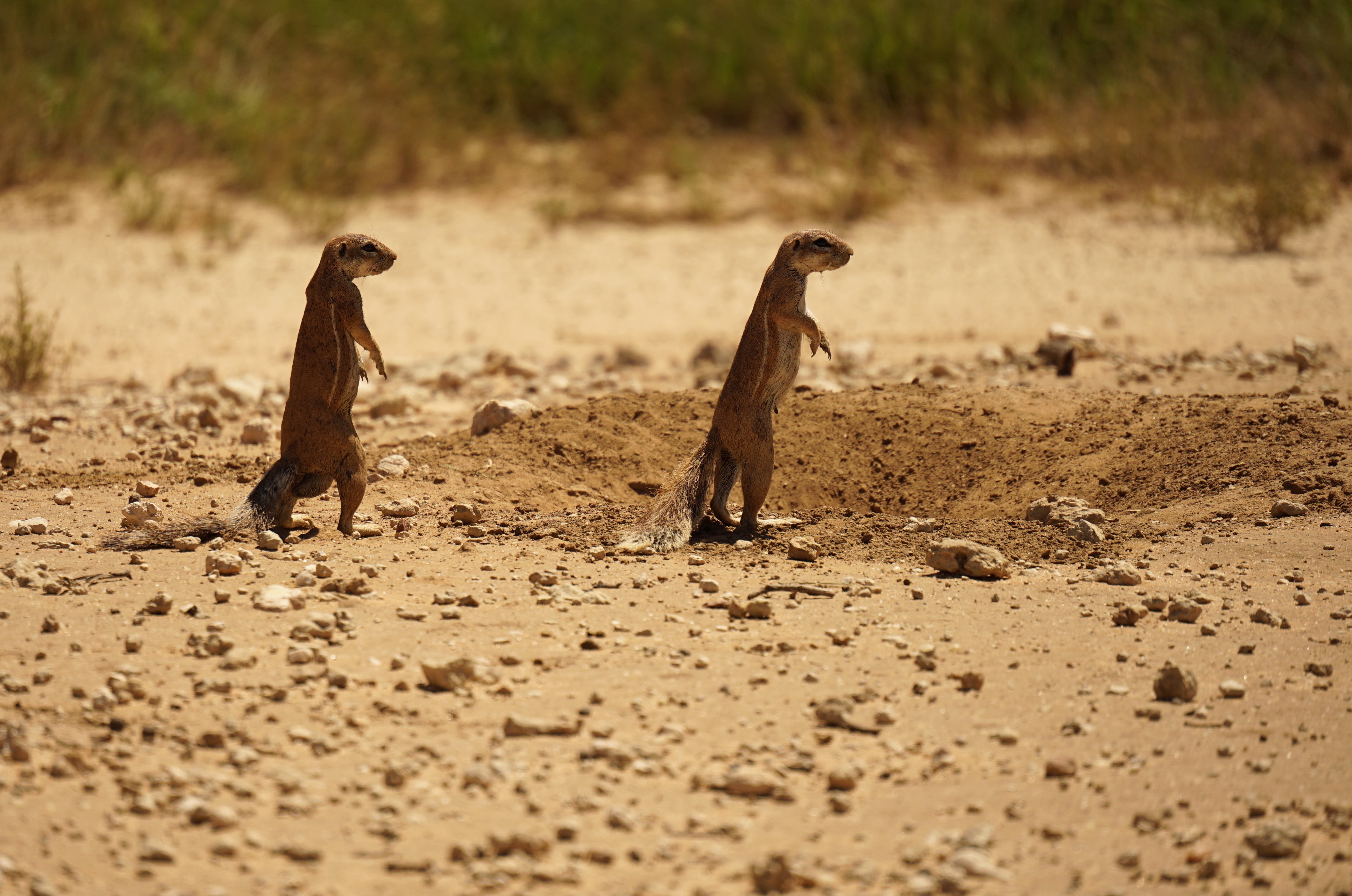
I’m particularly fond of the jackals and we’ve seen them in various moods — demolishing the remains of an old kill, playfighting, and digging in the sand then pulling out something long with evident delight. A ground squirrel perhaps, or a small snake. I love their jauntiness. They bounce along, bumptious and purposeful. Everything about them signals that they have places to go. Things to do. If I return to earth as an animal I might put in a request to be a jackal.
It’s been a wet summer and the desert is mostly covered in lush grass with carpets of yellow devilthorn flowers. Not what I expected but we got a taste of the desert landscape on an evening drive in a 4×4 with a ranger. Up and over steep red dunes. Again and again. We stopped to watch the sun go down. It may be a cliche but African sunsets and sunrises really are spectacular. The storms are impressive too, and one night early in the trip we lay snug in our rain-battered tent as the lightning flashed and great whipcracks of thunder kept us awake.

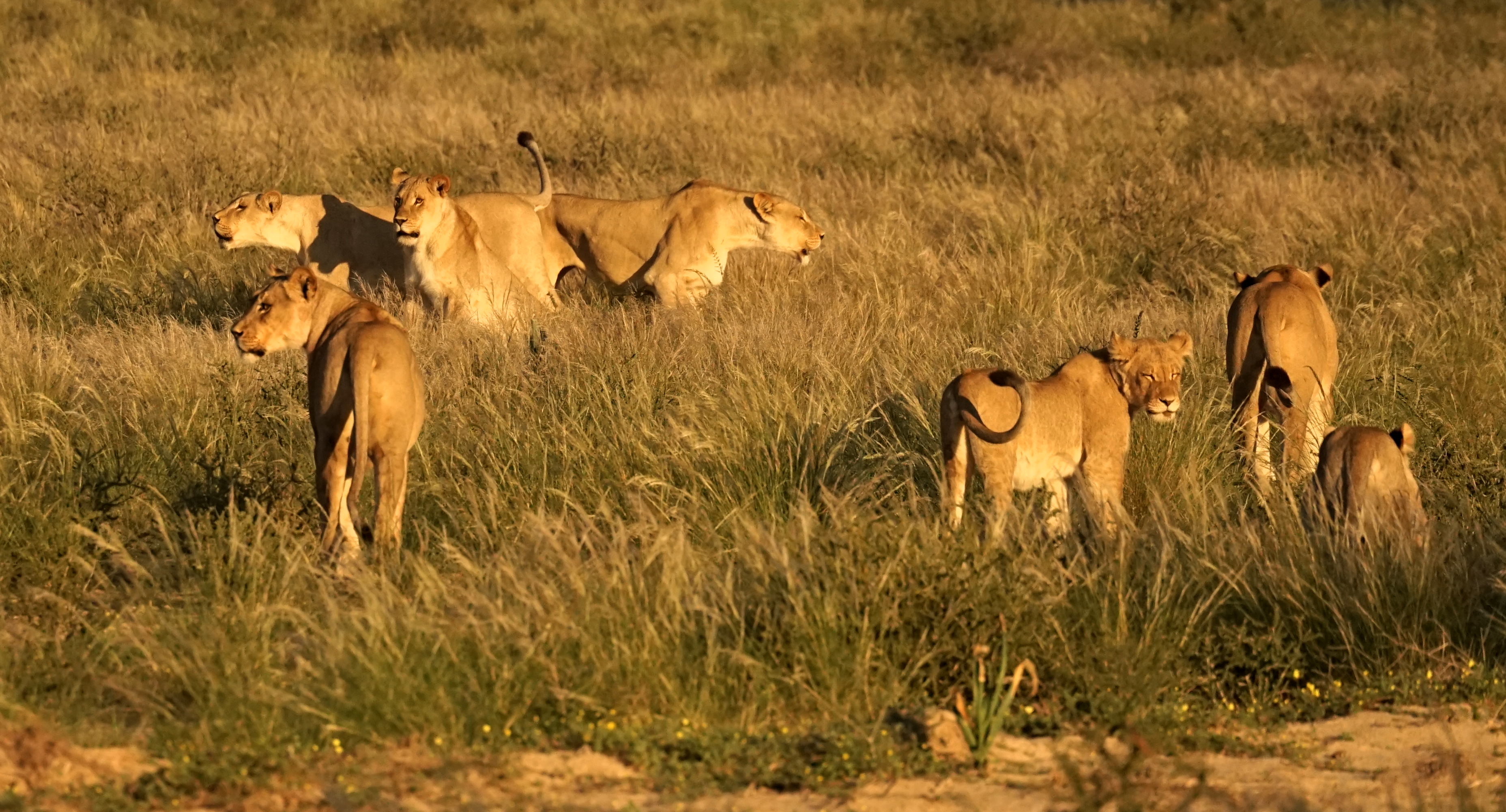
On the evening drive we came across a pride of lions lying in the road. It was dark and as the headlights lit up the road, they were unperturbed. Then they all stood up and wandered ahead of us — a couple of lionesses, two sub-adults and three chubby cubs whose progress was slow as they kept cuffing one another. One was particularly cheeky. A male adult lay in the grass to our right, far too proud to take part in cub-care. We also saw two Cape cobras on that drive. Butter yellow and several miles apart. Gliding along with sleek neat heads, ready to rise up at any moment with their hoods out. By that point I’d witnessed another camp kerfuffle with a snake-handler in pursuit of something black. Possibly a highly-venomous mamba or maybe a mole snake — non-venomous but can inflict a nasty bite. We never found out. This time the snake won the battle and escaped down a hole under a bush. Despite my initial fears, I’ve come to terms with the knowledge that at any point I could be very close to a snake. In fact, I know that right now there is probably a Cape cobra just yards away down a hole at the edge of Andries and Gaby’s chalet. Gaby saw it yesterday and the sand trails show that it has been in and out this morning. Similarly, I am containing my fear of spiders as at our last camp, I had to walk past the biggest, densest spiders’ web I’ve ever seen, on my way to the toilet block. It was strung up like a parachute in the branches of a camel thorn tree. I admired its magnificence but didn’t stop to seek out the residents.

We haven’t seen any scorpions…yet. Apparently they mostly come out when it’s windy.

Staring into the lion’s yellow eyes was a highlight of the trip and another came yesterday morning. We were just waking up when there was an almighty, unmistakable roar that sent us shooting out of bed and for the next few hours, a pride of twelve lions kept us enthralled as we stood on our verandah, sipping coffee and eating porridge. They drank at the waterhole, rested and prowled about. The cubs played, then huddled together keeping out of the way while the adults warned one another with great reverberating roars that shook the warm air. Eventually we had to get on with some everyday activities. Washing my underwear at the outdoor sink while keeping an eye on a lion, was a new experience. Later, as we prepared our evening meal under the starry sky, Andries observed, ‘We’re surrounded by lions.’
This feels a long way from my normal life. And a good place to be when terrible wars are kicking off. It’s a relief, too, to be in a pristine environment with no litter. And no worries about theft. The temperatures make everything harder but at least it’s a dry heat. All four of us are in our late sixties or early seventies and between us we’ve amassed a number of challenges. For me, hearing loss made worse by unfamiliar accents, painful corneal erosion exacerbated by the sand and dust, and the piercing sunlight which despite sunglasses has triggered frequent visual migraines. We’ve learned more about one another through living so closely and have had to navigate one another’s frailties, all the time aware that we want to make the most of what we have while it lasts.

We have two more days of blissful seclusion here and then one more round of tent-pitching at a camp where we are looking forward to joining two other intrepid South African friends. Then it will all be over and we will pass through the heavy metal camp gates for the final time. They will slide shut behind us and I will see the sign Keep gates closed. Dangerous animals. And as we start our long journey back to ‘civilisation’ and all the talk of war, I will wonder yet again which are these dangerous animals. Where are they? And most importantly, which side of the gate are they on?

Photos: Mike Poppleton

Comments are welcome. If you have difficulty posting here then email 60treatsandmore@gmail.com and I’ll post your comment for you.
Take My Breath Away

Apologies if today’s title gives you an earworm but this is something I’ve wanted to write about for a long time and until now, I haven’t known what to say. It has evolved very, very slowly because it concerns something rare and elusive. That’s why it’s so special and it happened for only the sixth time, a couple of weeks ago when I was on a train. I was looking forward to seeing an old friend, and spent the first part of the journey absorbed in a crossword. It was particularly tricky, so by the time I’d cracked it and took notice of what was going on outside the rather dirty window, we were well into Dorset, with Poole Harbour, misty and wide, filling the view. The train rumbled along, and as we left the water behind and I stared out idly, wondering what my friend’s ‘favourite cafe’ would be like, we passed a hill in the near distance, with sparse, bare trees on it — a wintry scene under a pewter sky. Then suddenly, there amongst the russet bracken, proud at the pinnacle, I spotted a stag standing completely still. It was surveying its landscape, and the sheer beauty of it took my breath away. ‘Oh my, it’s happened again,’ I thought.  It was a moment — a split-second when time seemed to freeze. It was a snapshot of pure wonder. 

The first time I became aware of this phenomenon was about twenty-five years ago. At that time I lived in deepest Sussex and one night shortly after Christmas there was a heavy snowfall. We hadn’t expected to wake up to such a crisp, white world but Harvey, our chocolate Labrador needed his exercise, so I put on my boots and set off with him for our regular walk through the woods. The cover was absolute and pristine. Not a blade of grass could be seen and bare branches bowed beneath the weight of the captured snow. It was a fairytale scene, as quiet as can be and I was lost in daydreams about the coming week. Then something startling happened. An auburn fox raced past about ten yards away running as fast as it could with my dog in hot pursuit. It was a few seconds of silent film. Maybe two. Three at the most. The fox got away but the intentness of the two animals and the stark palette of white, brown and auburn were breathtaking. It knocked me sideways and I knew that moment had been something precious. I didn’t have the words to describe how it made me feel and it took another fifteen years before I had another similarly overwhelming experience.  

That time I was in Worcester for a weekend on my own. The Cathedral is surely one of the loveliest in England and as I walked through the Edgar Tower into the precinct, College Green opened up ahead, an oval of grass surrounded by houses of cream, sage green, and shell pink. There were yellow and violet crocuses under a tree, and frothy blossom above. In the background I could just see the river. Then all of a sudden as I stood there, taking in the gorgeous scene, the cathedral bells started pealing and my mouth literally fell open. It was pure perfection. This time, I recognised the feeling but as before, I couldn’t find the right words to describe it. 

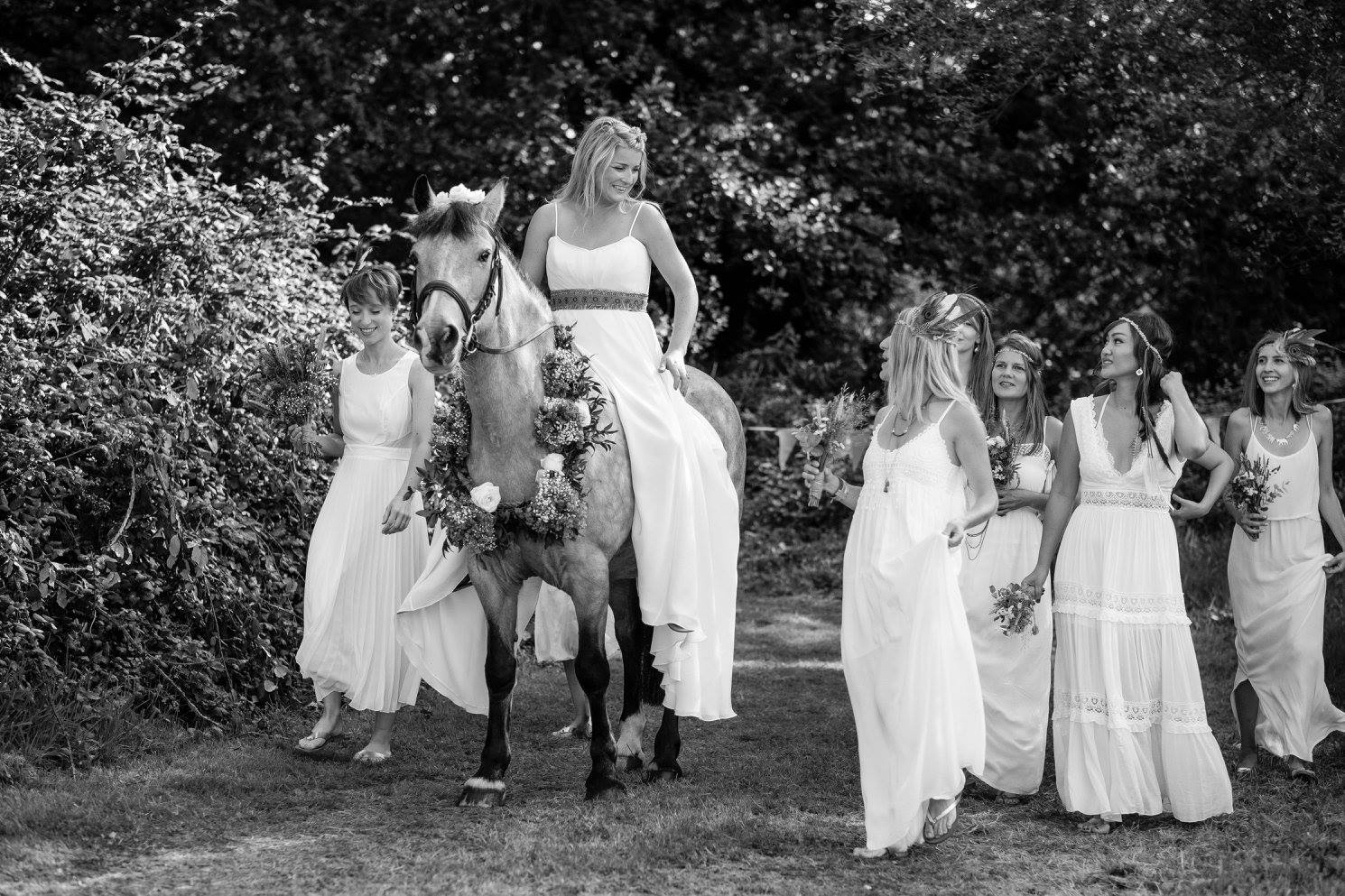
A few years later it happened again. I was sitting on a floral-adorned, straight-back chair in a garden – English greenery all around and a gathering of smartly-dressed people chatting quietly and waiting for something to happen. There was palpable poignancy, too, as so many of us remembered our friend Nicky, mother of the bride, who was no longer with us. She would have loved this. And then a hush, followed by row after row of gasps, as Emma the bride, came into view, in a simple white dress, riding side-saddle on her horse and flanked by woodland fairy bridesmaids. Once again, there was a shiver of magic and time stood still. 

Two years passed until it happened again. I was on a bus in the Japanese Alps and as it spun nauseatingly round bend after bend, I was becoming increasingly miserable. Then… it swung round yet another bend and there in the distance was Mount Fuji. Ravishing and unmistakable with snow drizzling down the slopes like a fancy pudding, and a fluffy garnish of cloud on top. I was astonished to feel so moved by it. It was a gift that took me completely out of myself and I forgot about feeling sick. 

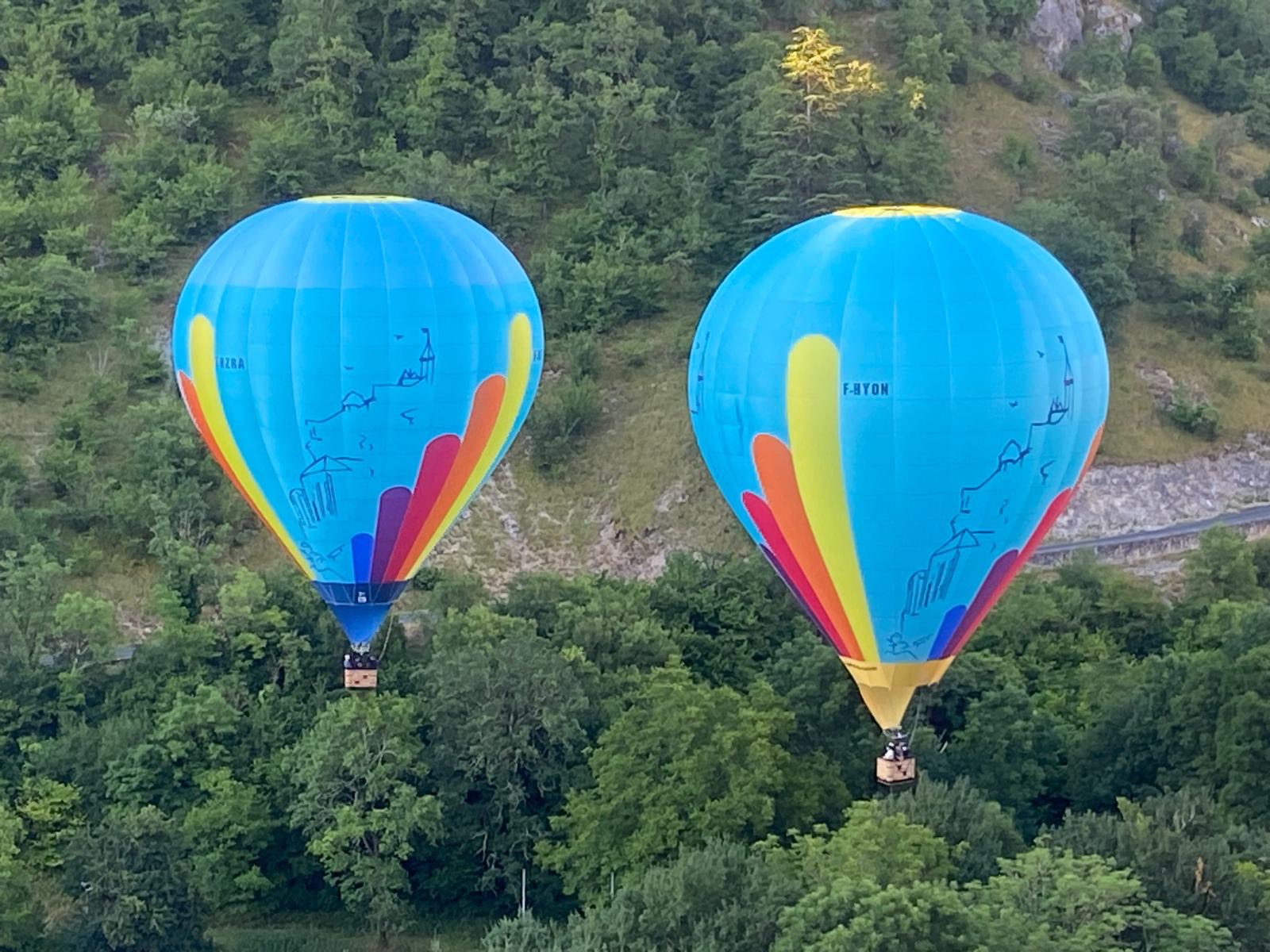
It took six years for the next ‘event’ to present itself. This one happened in France — Rocamadour in the midst of a heatwave, and it was so stifling that we could only walk early in the morning or in the late evening. Our accommodation was just yards from the church of Notre Dame built high in the cliffs above a gorge of the Alzou river, and just after dawn as we yawned and wandered through the ancient building, we heard a whooshing noise. I assumed that street cleaners were out early with their machines, preparing the village for the daily influx of tourists. But as we reached the terrace and looked down over the gorge, we saw immediately where the noise was coming from. Two huge hot-air balloons were drifting past in the cool of the early morning with their gas burners spouting controlled flames and passengers standing rapt in the baskets. That first sight of them took my breath away and we too, stood rapt and watched until they were out of sight.

Ever since it happened the second time, on College Green in Worcester, I’ve been searching for a way to describe the feeling to myself, let alone trying to explain it to anyone else. I’ve tried out various words and phrases – flashbulb moments…an intense moment when the world seems perfect…a sense of being deeply connected to the world…authentic moments…pure joy…intoxication…deep harmony…wholeness…a momentary, complete appreciation of being alive…spirituality… Ecstasy, even but I shy away from that as it sounds religious or a bit carnal. I think that some people might call this awe but I don’t think that’s what I’m struggling to describe. I’ve stood in front of incredible works of art, and been in spectacular places — the Sagrada Familia in Barcelona comes immediately to mind —but I expected those things to be astonishing. What is different about the six ‘flashbulb moments’ is that they all involved something unexpected. I know that I can’t be alone in noticing this sublime phenomenon and over the years I’ve come across other people who have also attempted to describe something that seems similar. 

In his memoir, Chasing Daylight, Eugene O’Kelly refers to the perfect moment he experienced once on a golf course. A hawk swooped down to the lake right next to him, plucked a fish from the water and flew off past his head. And in her memoir, Old Rage, the actress Sheila Hancock writes with passion about an experience she had during the war, as an evacuee child in Dorset. She was holding a friend’s hand and swimming naked in the dark, in a pool by the sea at Dancing Ledge when she was overwhelmed by the magnificence of the sea and love for her friend. ‘It was a moment of complete happiness,’ she writes. But these experiences can’t be manufactured to order and when at a later point in her life, she returned to Dancing Ledge, she found that she could not recapture the feeling. Wordsworth, too, writes about spots of time. Vivid, cherished moments of intense, often natural, experiences that can be revived in the memory and which create a lasting connection between the past and the present. 

Over the years since that first experience, I’ve wondered and wondered. When will the next one happen? Will there be a next one? How can I explain it to anyone else as it’s only by finding the right words that you can share your experiences precisely and find out how life feels for other people. And then just a few weeks ago, it was Sir Michael Morpurgo who gave me the key to understanding my own experiences better. I was listening to his collection of essays — Funny Thing Getting Old – and yes, he writes about getting older, the topic that first attracted me to it, but he also writes about books, peace, war, optimism and gratitude. And most importantly, he writes about nature. It is beautiful writing throughout but one chapter resonated above all the others. In it, he describes how for more than fifty years he has taken a morning walk along the isolated valley of the Torridge where he lives in Devon. As he walks it helps him to come up with the wonderful stories that he writes for children —War Horse, Private Peaceful and so many others — and in all of those years he has seen many herons and ducks, and an occasional kingfisher but never an otter. Then one day, quite out of the blue, an otter popped out from under the water. It stared at him and he, staying perfectly still, stared back. The animal dived back down and to his delight it came up with a fish between its paws. Time and time again – he estimates at least eighty — the otter popped up, sometimes crunching on a mussel, once with an eel. It knew he was there but it didn’t mind. For forty minutes he stood, entranced. Then it was gone. ‘But the thing is,’ he says with characteristic wisdom, ‘…it wasn’t gone because that memory will be with me for the rest of my life.’

And that’s it. That’s exactly it. His ‘otter moment’ lasted longer than any of my experiences but I understand just what he’s talking about. My ‘flashbulb moments’ took my breath away and the memory of each of them will be with me for the rest of my life. Maybe you’ve had similar experiences. Maybe you’ve come up with your own way of describing them. I’d love to hear. Do put something in the comments section or email me on 60treatsandmore@gmail.com and I’ll post it for you. 

Dating – Part Two 

My last blog, Dating – Part One, was all about what to do when you come to the end of a big absorbing project and are not sure how to fill the new void. That’s where I found myself after finishing How I Learned to Stop Saluting Magpies, – in need of a break from writing, and a long think about what to write next. Even whether to write. 

This break has resulted in a surprisingly satisfying uncreative autumn and early winter. Except I suppose it hasn’t been uncreative really because that human drive to create is always there in all of us, even when it’s not actually producing anything that anyone else is aware of. And during these quiet months I’ve had Julia Cameron’s The Artist’s Way by my side. This 12-week programme claims to have helped millions to discover and recover their creative self, whether that’s writing, painting, photography, needlework, music, baking, gardening or any of the many other ways that humans express themselves and explore ideas. I came across it because many of my writing friends have, at some point, tried it. 

I didn’t follow all the suggestions but overall it’s been well worth doing, and I did practise the two main pillars of the programme. One is morning pages – free flow writing about whatever comes into your head. I don’t always have the time to do this but can see the benefit, as unexpected ideas and thoughts pop up, as if from nowhere. The other tool, artists’ dates, has gradually revealed its value. This is when you set aside a minimum of two hours, once a week, for doing something that feeds you. Julia Cameron describes it as an excursion or a play date that you preplan and the key thing is that you must do it on your own. ‘Resist all interlopers,’ she says. ‘And don’t worry if any of the dates seem silly. Creativity is a paradox. Serious art is born from serious play.’

In Dating – Part One I wrote about my first artist date, which was a delight. A slow, solo lunch in a French restaurant, that changed my attitude towards mussels. And now I’ve reached the end of the programme and so that means I have had twelve dates with myself. They’ve included a couple of amateur theatre outings, an exhibition about the background women in Jane Austen’s novels, a guided walk around Southampton, an art study day, a book launch in a Winchester bookshop, and some lunchtime folk music at the local university concert hall. That last one took me outside my comfort zone as I’ve never been into folk but I’m so glad I went, as I really enjoyed it. The only real disaster was a treasure hunt using an app on my phone. Boo to that one. Having paid my fee and got myself to the start of the trail, I couldn’t find the first clue and it refused to let me progress to the next one unless I took some selfies of myself ‘enjoying’ the wonderful app. Boo again to that one.

The ones I particularly enjoyed, were both in London. Neither was the main reason for being in the capital but they were each stimulating and added extra pleasure to a couple of days out.  One was a stroll around Marylebone with a London Walks book. It did an excellent job of guiding me towards charming Georgian squares and pointing out things of historic interest. The other took place on the South Bank. I headed for the BFI (British Film Institute) building and at the entrance I was greeted by a woman in a smart jacket, black trousers and a white shirt, carrying a short-wave radio and wearing an earpiece. ‘Hello,’ she said. ‘Are you here for the summit?’  I wasn’t but it was a reminder that this building is at the heart of the British film world. She directed me down a side road to the BFI cafe where I sipped my oat cappuccino and relished being in a place where everyone looked animated and interesting. But it was the Mediatheque I was there for and it didn’t disappoint. Anyone can just walk in and take a seat at one of the booths which each have comfortable seating, a screen and headphones. There you have a choice of 180,000 items in the BFI Archive and it’s all free. Where to start? I dabbled with the finale of the influential 1950’s science fiction saga, Quartermass and the Pit; a boundary-pushing episode of Armchair Theatre that explored racism in a white working-class family, and a docu-drama about Cromwell’s determination to kill King Charles I. It was wonderful but rather overwhelming so in the end I decided to search for the item that was closest to my birthdate in 1959. 

It turned out to be a documentary that was aired the day after I was born. Reporter, Michael Ingram joined a team of dustmen on their round in Westminster Public Cleansing and Transport Department. There were no wheelie bins then, just the round, dented metal dustbins I remember from childhood. No compressor on the lorry, and no safety gloves for the workers. They were all white, with bad teeth and they spoke deferentially to the posh presenter in his smart overcoat. ‘Yes sir.’ ‘No sir.’

I finished off with a documentary that was shown at the end of 1959. It was an overview of that decade when I was born and which I’m fascinated by – perhaps because I’d been on earth for less than a year when it ended and so I don’t have any of memories of it. Made by Granada TV, it was hosted by Ian Carmichael with shiny Brylcreemed hair and a perfectly knotted tie, and interspersed with upbeat jazzy music. He delivered the good news that for the first time in many years there was nowhere on earth where British soldiers were fighting, and then noted the rise of various personalities through the fifties – Kenneth More, Pat Smythe, Tommy Steele, Stanley Matthews and Princess Grace of Monaco. He called Khrushchev, ‘a dictator with the face of a children’s party balloon.’ ‘We became more real about ourselves during this decade.’ breezed Carmichael, contrasting clips from two films. Spring in Park Lane at the start of the decade – all careful manners and romantic lighting – with rough-edged, sexy Room at the Top in 1959. It was The Dull Decade according to Nancy Mitford, while the Archbishop of Canterbury called it The Selfish Age. It was a fascinating insight into the history of the time but as I had a lunch date with my cousin, I tore myself away. 

The value of these solo expeditions is that they helped to clarify what I’m really interested in. It’s not writing fiction that makes me happy – at least not at the moment – but instead it’s a mix of social history, lots of walking, exploring new areas, and discovering unexpected curiosities and treasures. And where better to do that than London where I lived and studied for years, and which has a claim on my heart. I know I’m happiest when I have a project to get my teeth into. But I also want some balance in my life. So I have a plan. Thirty day trips on my own over the next couple of years. There is a unifying theme, and purpose to it all but I won’t know if that will work until I try it. I expect it will need to be tweaked and it might not turn out how I expect. In fact it almost certainly won’t. But that will be a story in itself. I start tomorrow. Nothing like a New Year for a new project. And I can’t wait. 

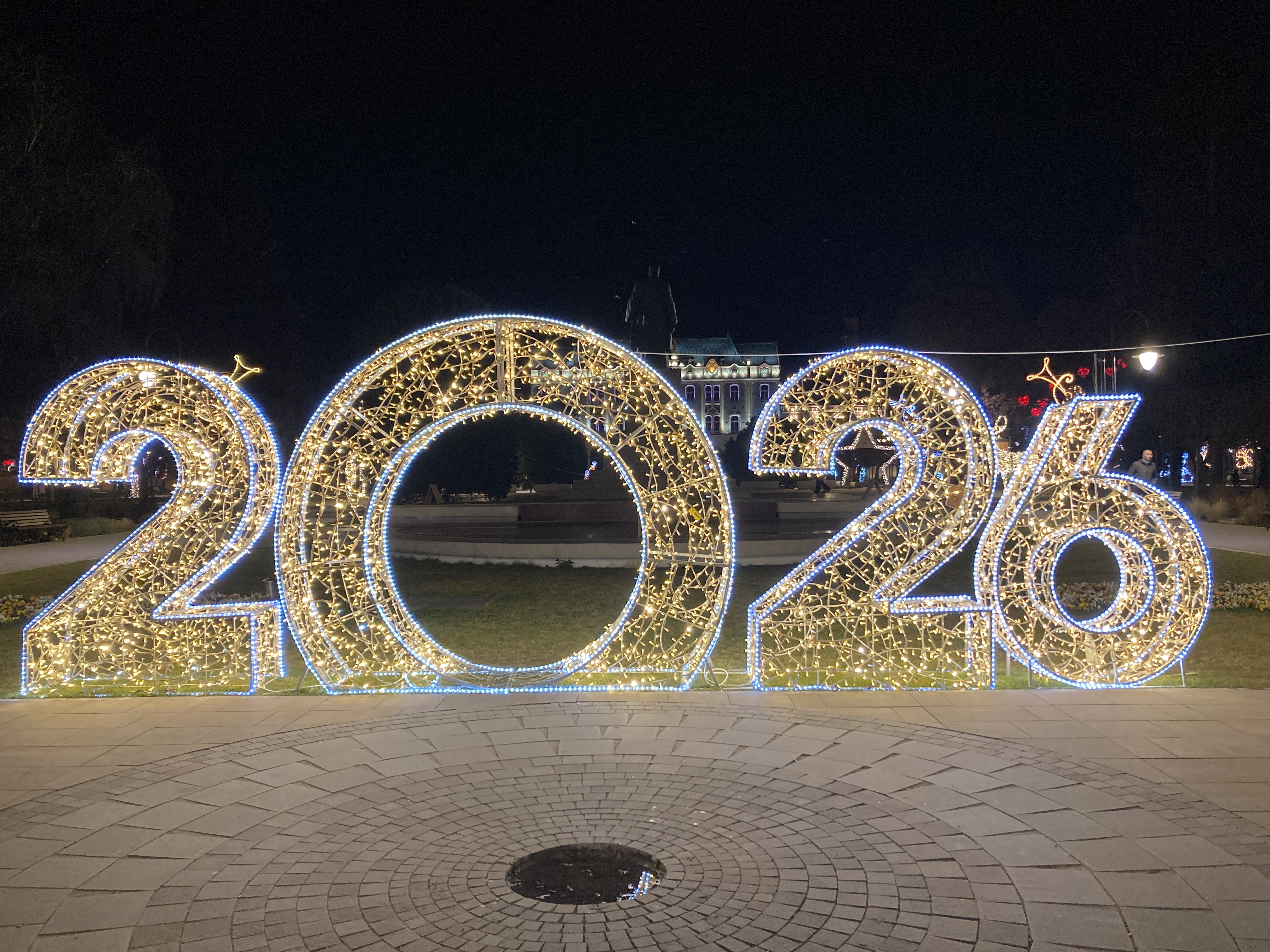
Wishing you many good things in 2026 and as always, thank you so much for reading this. 

Dating – Part One

It’s a couple of months since I finished How I Learned to Stop Saluting Magpies and I’ve taken a break over the summer to mull over a new writing project and recharge my batteries. But it’s September now and I’m keen to get started.

As this next idea is different from what I’ve done before,  I’ve found myself searching around for ways to approach it, and one strategy has been to turn at last to a book that’s been sitting on my desk for several years. The Artist’s Way by Julia Cameron was written in 1992 and comes highly recommended. Millions of people have done this 12-week programme that claims to help you discover and recover your creative self, whether that’s writing, painting, music, acting, photography, needlework, gardening or any of the multitude of other ways that humans express themselves and explore ideas.  

I read the introductory chapters of the book and although I couldn’t connect with everything the author was saying, I decided to try using the two key tools that she advocates and to see what happened. The first one – writing morning pages – requires you to fill three A4 pages at the start of each day. Just free flow writing about whatever comes into your head. I’ve now been doing that for two weeks and it’s been remarkably helpful and productive because once I’ve had a moan about who has annoyed me, and which bit of me is aching today, I’ve usually only filled half a page. It’s then that I start unpacking ideas, often surprising and random, and I can only be grateful and wonder where on earth they’ve come from.   

The other tool is to have an Artist Date once a week. This is when you set aside some time, perhaps two hours, for doing something that nurtures you. Julia Cameron describes it as an excursion or a play date that you preplan and the crucial thing is that you must do it on your own. ‘Resist all interlopers’ she instructs firmly.

Week One – and as I needed to be in Winchester for a meeting on Friday morning, I decided that my inaugural Artist Date would be to take myself out for lunch and to order something that I wouldn’t normally eat. 

I chose a French restaurant in the centre of town and when I entered, the waiter smiled expectantly. ‘What time is your reservation?’ he asked. I didn’t have one, and he looked dubious. Then he said, ‘I think we can squeeze you in,’ and took me to a small table by the window. It was perfect for dining alone and I settled down to read the menu. I’ve always been suspicious of mussels and so I challenged myself and ordered moules marinière. Frites might be the traditional accompaniment but as I don’t eat potatoes, I ordered bread and a green salad. A succession of servers arrived, each with a different job and a big smile, bringing sparkling water, a finger bowl, and a large empty dish for depositing the shells. Then eventually one of them placed a large plate of steaming mussels in front of me, adorned with finely chopped parsley and smelling of the sea. I took a slow breath in to savour the moment and as I took my first taste, I gave a spontaneous groan of pleasure and was grateful that the adjacent table was still empty. The salad came with small chunks of luscious avocado and a sharp, lemony vinaigrette and the bread was so good that it could have been baked in France that morning. It was the perfect dish for a solo lunch as each mussel has to be attended to individually and so you have no option but to eat slowly.  

I listened to the happy buzz of smartly-dressed Winchester ladies, out for lunch in twos and threes, and when all the shells had been transferred to the debris dish and I’d had enough bread, there was still plenty of the delicious creamy, briny juice. So I asked for a soup spoon. I finished up with a café gourmand – an excellent coffee with three mini-desserts. The only downside was lingering a little too long and having to run to the bus stop. Not comfortable after a good lunch.

I went home feeling thoroughly contented though still not quite sure why these dates might be good for me. But when I woke up the next morning I had a moment of clarity. I realised that during that lunch I’d felt fully alive – in a very different way from if I’d been chatting with someone because I’d paid attention to everything. The tastes, the smells, the service, the surroundings. Which is not only life-enhancing but helps to set off thoughts that feed creativity. I deemed it a success and started wondering what I might do in Week 2.

As it happened, I had to go to London on Friday and decided that when I’d finished, I would take advantage of the late opening at the National Portrait Gallery. I imagined myself wandering around contemplative and serene, as I got acquainted with some of the 11,000 Britons on the walls. 

Unfortunately I cut things a bit fine – when I got to my local station, the train was already in, and as I dashed onto the platform, the doors slid shut. I stood helplessly while it waited the standard humiliating thirty seconds and then glided off without me. This was going to mess up my commitments for the first part of the day, so I gave up on those and went back home to reconsider my Artist Date. 

‘I know,’ I thought. ‘I’ll take the Number 1 bus from the top of my road and that will drop me near Shawford.’ The village railway station has a cafe that’s been rescued and restored by a local heritage project and I’m curious to see it. I set off for the bus stop, imagining myself relaxing in charming surroundings with coffee, delicious cake and a book. Not quite as exciting as wandering around a London gallery after dark but after all, Artist Dates don’t need to be fancy. In fact I guess it’s important that they are not all fancy, otherwise they’d be both demanding and expensive. 

After my earlier public transport mishap I left plenty of time for the walk to the bus stop. But as I neared the top of the hill and the main road, I spotted a Number 1 bus whizzing past. It was followed shortly by another one. That didn’t bode at all well. They clearly weren’t running according to the timetable but I was determined to stay optimistic so I carried on to the bus stop and stood there patiently. Fifteen minutes passed and then I managed to get onto the website which informed me that the next Number 1 bus would be along in twenty-three minutes. By then I’d had enough of waiting so I had a rapid rethink and came up with Plan C. I’d downgrade yet again and walk to Costa Coffee on the nearby university campus. It should be quiet as the students were still on vacation. I set off briskly along The Avenue and three minutes after leaving the bus stop, a Number 1 rumbled past. It was followed two minutes later by another one. Maybe I was imagining it but as I walked along the road looking miserable and getting wet – because by now it was raining – the passengers on the lower deck looked particularly happy and pleased with themselves. 

A hundred yards past the next bus stop I spotted a blue double-decker in the distance, travelling in my direction. Another rapid change of plan. It was not too late to revert to Plan B so I started running as fast as I could back to the bus stop. As I got there, panting, the bus approached and I saw that it said Not in Service. That’s an awful lot of public transport misfortune for one day but I promise, dear reader, that I would not lie to you.  

In the end, I did walk to the campus Costa and spent a pleasant hour reading a novel that transported me to the 1930s and the mountains of Kentucky. All whilst nursing a latte and a slice of lemon drizzle cake. It wasn’t quite the date I’d planned but I wouldn’t normally have set aside that amount of time during the day just for myself, so it was worthwhile. We all know that dating is a risky and uncertain business and it seems that’s true even when you’re dating yourself. I’ve got another ten weeks of Artist Dates to go – I’ll let you know how I get on. 

How I Learned to Stop Saluting Magpies

Hurray! It’s finished. 

This week I took delivery of the first copy of my book – How I Learned to Stop Saluting Magpies. After all the work and glitches, it’s thrilling to see it in its completed state. Jo Dalton has come up with a beautiful cover and Dawn Black the interior designer has also added a touch of magic. I’m grateful to them both. These have been very happy collaborations after months of working on my own to shape the story and the ideas, as faithfully and curiously as I can. 

Along the way, I’ve read dozens – perhaps hundreds – of books as I’ve explored an eclectic set of topics – from flamingos to Russian history, via Jane Austen, fish, classic films, superstition, trains, Japanese culture, forgiveness, slow living, anxiety, painting, long-distance walks and a mysterious grandmother. And much more. Like I said, it’s eclectic. 

It takes — at least it’s taken me — a long time to get from the initial concept to the final product. Somewhere between four and five years. I can’t be sure of the exact date but know I was walking on the Cornish cliffs when the idea for it suddenly came into my head. It blew in with the wind like Mary Poppins, and then it wouldn’t leave me alone.  It’s a sequel to my first book 31 Treats And A Marriage but with quite a different slant.

I nearly gave up several times. When my laptop was stolen from a train somewhere between Amsterdam and Berlin, I lost my research notes. I use a writing tool called Scrivener and thought everything was being automatically backed up, as that was how I’d set it up. Turns out it wasn’t. Something very odd had happened and no-one could work out what had gone wrong. The helpful people at Scrivener did their best but were mystified. Thousands of words and months of work – all gone. I nearly gave up then. But I bought a new computer, took a deep breath, drank lots of coffee and started up again. 

Then there was the period of creative block when out of the blue I simply lost the desire to write. It was frustrating and perplexing and I wrote about it here. That was when I learned that we all need seven different kinds of rest, and I was due for some creative rest. Thankfully, after about four months, I re-engaged with the writing process and learned to love it again. 

There is joy in completing this book but also sadness. My dear friend Anne Stanton was always so encouraging of my writing, and made such thoughtful comments about my previous books. She was often in my mind while I was writing, but she will never get to read this one, as she died of bone cancer in November last year. Similarly, Chris Harris — a wonderful man who was so well-read but made time to read my books, and to comment so intelligently on them. He died in January. I miss them both.

If you would like to find out how I learned to stop saluting magpies, and why it was so necessary, then the book is available in both paperback and Kindle versions. It takes a while for publishers’ details to appear on some websites so don’t be put off if you see an ‘out of stock’ message — it’s currently listed by Blackwell’s and Amazon but should be available to order through all good bookshops. If you read it, I would be thrilled if you find something interesting, something useful, and something that makes you laugh out loud. Something, too, that prompts a conversation. Preferably lively. And if you like it, please do consider leaving a review — it makes a big difference.

And now the moment has come…

You’ve been a long time in the making, little Magpie. It was just the two of us for those years—quiet hours, exploration, the slow shaping of something uncertain—and although I could never be confident that you would find your way out of my imagination, you have. It’s been such a rich experience and I will miss you. But nothing lasts forever, and now that I can hold you, it’s time to set you free. Flap your wings. Spread them wide. You’re ready to fly.

How I Learned to Stop Saluting Magpies: A Lifeline List and Letting Go of Fear. 2025. Esmeralda Publishing. ISBN 978-0-9934711-2-4

If you would like to leave a comment and are unable to log in to your WordPress account, just email me on 60treatsandmore@gmail.com and I’ll post it for you.

The Day that Stopped

Last weekend we were in the French Pyrenees. Mike had spent four days on a photography holiday with friends in the beautiful old town of Villefranche-de-Conflent, and I tagged along, enjoying the socialising, scenery, and delicious food while making final edits to my new book. On Sunday morning we said a fond farewell to our friends and set off on the Petit Train Jaune for a few days on our own in the village of Enveitg at the end of the line. The three-hour ride through the mountains was breathtaking. 

We arrived at lunchtime, dropped our bags at the Airbnb apartment and walked to the one and only local restaurant where we enjoyed an elegant salad, lasagne and tarte Tatin—my favourite pudding. After a good lunch it was tempting to have a nap but it seemed a shame to miss out on the stunning scenery and warm weather, so with the nearest town only a few kilometres across the border in Spain we decided to take a stroll. There was plenty to look at. We passed huge auburn cows with bells round their necks, constantly clanging like a call to prayer, and delicate calves soaking up the sunshine. In the background were great mountains with residual snow, and bare ski runs gashing the slopes like scars. As we walked, the small town of Puigcerdà came into view, perched like a hill fort to our left, with houses in shades of yellow, ochre and brick red. At some point we must have crossed the border. There was no obvious sign but the linguistic clues were there. A board by the side of the railway line was in Spanish on one side and French on the other. And as we went further there were fewer Bonjours and more Holas.  

When we arrived in Puigcerdà we explored the winding streets—languid in the Sunday afternoon heat— and cooled off with drinks at a bar in the main square. Then we took the free funicular that connects the upper town to the lower level. There, we bought some groceries at a convenience store where the owner was keen to practise his English. He told us about his love of cricket and gave us a bottle of pink Powerade as a gesture of international friendship. 

It had all been so pleasant that the following morning we decided to revisit Puigcerdà—this time so that Mike could put his new photographic skills to use. It was late morning when we arrived and we sat at a cafe looking out over a lake with a border of black poplars, and watching the waterfowl engage in noisy, splashy squabbles. At about 12.45, Mike went to the counter to pay for our drinks but he came back looking worried. “The waiter says there’s a problem with electricity…the whole country is cut off.” 

“It can’t be,” I said. “That sounds ridiculous.” And then I remembered how we’d not been able to make contactless payments in a London branch of Marks and Spencer the previous week. That was when it started to feel strange and sinister. How could the whole country be affected? Was it a deliberate attack? Like those that had paralysed Marks and Spencer, the British Museum, the NHS, and Transport for London, to name a few. Fortunately our phones were still working and the main thing I wanted was to connect with family so we messaged them, and they knew nothing about it. But gradually as we checked in with trusted news sources—The BBC and the Guardian—reports started to come through. They too, sounded like they could hardly credit it. “We are getting reports of…” And then it emerged that not only was the whole of Spain affected but so was Portugal. Parts of France too, and Andorra. 

Neither of us speak Spanish so we had to watch carefully, and try to interpret cues from the people around us. I nudged Mike when I spotted a woman dashing along carrying a large pack of bottled water, and pushing a toddler in a buggy. She looked purposeful—as if she needed to get home as soon as possible. Then I saw another and another. All with the telltale packs of water. We passed a grocery store but it was a dark cave with a worker guarding the entrance and telling hopeful customers that it was cash or nothing. 

We had some euros with us which was lucky as the ATM screens were all blank, and already banks were closed, with hastily written notices taped to the windows. By this time it was about half-past one and we were getting hungry. We spotted a pizza restaurant with big glass windows and I had a rush of optimism when I saw people eating inside. Perhaps the crisis had been resolved. But as we approached I saw a waitress standing in the doorway and gesturing to a small group of people that they were about to close. We walked a bit further and a white van went past. I noticed that it said Ingeniero de ascensores and worked out that it must be a lift engineer. My first thought was that they were on their way home for lunch and possibly a siesta. Then with a jolt, I realised it was more likely that they were off to rescue someone stuck in a lift. Or the funicular we had taken yesterday.

We walked on and came to an organic cafe. The server looked harassed but smiled and said we could have a salad. No coffee of course. And while we were waiting for our food, we got into conversation with a sharply-dressed local man who spoke good English. “It’s a cyberattack,” he said. “Definitely. Nothing like this has ever happened before.” Then he added, “The internet will stop working soon. And then we will all be dead.” He made a cutting gesture across his throat, and looked remarkably cheerful.

After lunch, we decided to give up on our Spanish jaunt and walk back to Enveitg. Perhaps things would be better across the border. As we made our way out of Puigcerdà, the streets were deserted. The green cross pharmacy signs, ubiquitous across Europe, had lost their comforting illumination and the petrol station at the end of the street had shut down. What would happen when people ran out of petrol? Then Mike looked at his phone. “I’ve lost the internet,” he said and an image of the young man with his doomy gesture passed through my mind. 

It was just a few kilometres back to our village but what a difference that invisible border made. Our internet connections returned almost immediately and we saw lights inside buildings. All seemed normal at our apartment and we needed the reassurance of the familiar, so the first thing we did was to make a cup of tea. As we were drinking it and mulling over the day’s events, our host stopped by. She works at a hospital across the border and told us that generators had kept emergency services going. Then she said, “It’s not just Spain and Portugal, you know. It’s affected Germany. Sweden too.’’ Misinformation spreads fast.

What can’t be disputed is that this was Europe’s biggest blackout for twenty years. Inevitably it takes time to diagnose complex problems in a complex infrastructure system and so far there has been no consensus about the cause. Initially the Portuguese authorities blamed extreme weather in Spain but later the Spanish met office reported that there had been no unusual temperatures. Most reports now suggest it was a ‘Black Swan event’ when a variety of unlikely things happen at the same time, thereby setting a cascade of failure in motion.  

We’re home now but the experience has given me pause for thought. Since the pandemic, I rarely carry cash and I try to use up what’s in the food cupboard, so supplies tend to be low. After all, you can always go shopping, or order on the internet… 

When I read, earlier this year, that the EU was advising its citizens to keep a stock of food, water and medicines—enough to last at least 72 hours—it seemed dramatic and guaranteed to cause anxiety. They named a range of potential emergencies including war, floods, fire, pandemics, and cyberattacks, and talked of the need to develop a ‘preparedness mindset.’ 

On this occasion, the young man in Puigcerdà was probably wrong in assuming malevolent causes, but we know attacks happen, and it’s disturbing how long it’s taking for Marks and Spencer to recover. When we arrived back at St Pancras station ten days after the initial problem, and in travel-worn need of a sandwich or a salad, the shelves at M&S were bare. That cyberattack came out of the blue and so did the blackout. I’m going to stock up on food, water and medicines, as suggested, and also keep some cash. The advice to put together an emergency kit of torch, batteries, first-aid and a wind-up radio seems rather more urgent than it did a week ago.  

What A Lot of Rubbish!

Overwhelmed. Frustrated. Angry. Impotent. These are words we hear a lot these days. And on the flip side, since November’s US election results I’ve heard many ordinary people say that even if we can’t influence the big picture, we can make a difference in our own sphere. On the one hand that sounds so trite that I hesitate to repeat it, but on the other I know that in the absence of much else, it is advice worth acting on. Smile. Make time for people. Tell service workers when they’ve done a good job… All suggestions gratefully received in the comments section below. 

As a mindset, it’s one way to cope. And we need plenty of those. My keystone is a daily walk. Preferably in the woods amongst trees but I’m happy, too, on suburban streets when a local errand transforms into vital exercise and calming headspace. Whether I’m tuning into birdsong or an audiobook it’s an important component of my day, and sanity. But recently, I’ve been increasingly distracted and saddened by rubbish. It’s everywhere. From amongst the nourishing natural order of leaf mould, fallen twigs and daffodil buds, loom lurid assaults from discarded Red Bull cans, greasy fish and chip papers, foil chocolate wrappers, and plastic Burger King milkshake beakers—still with the straws stuck in them. I try not to notice. But the idea of people casually discarding their rubbish is upsetting. Many years ago, when I lived in London I was walking past a queue of cars when a driver wound down his window and threw his empty fag packet in my direction. Wordlessly, I picked it up and dropped it on his lap. ‘I pay my council tax,’ he growled and chucked it out again. 

I often think about the comedian David Sedaris who has become obsessed with litter picking in the West Sussex village where he lives. He’s so well-know for it that the local council named a bin lorry in his honour. On the side are the words, Thanks David for helping to keep the area clean. “You can tell where my territory ends and the rest of England begins,” he says. “It’s like going from the rose arbor in Sissinghurst to Fukushima after the tsunami.” I admire what he does. But have to wonder—what kind of a mug picks up other people’s rubbish? 

Then last month, I was chatting with my friend Felice. Like David Sedaris she is originally American but has lived here for many years. She always makes me think. We were talking about the state of the world and how I feel impotent. “We have to hold our commitment to our values,” she said. “No-one else can do that for us.” Afterwards, one thought led to another and so it was that last Monday I found myself going out for my usual walk, armed with a bin bag, sturdy gloves, hand sanitiser, and my brand new litter grabber, bought online from the Helping Hands Environmental Company.  I was nervous and sure that people would think I was weird. But that’s irrational. As David Sedaris says, “How is it fair that the person who rips a lottery ticket into 16 pieces and throws it on the ground isn’t crazy, but the guy who picks it up, is?”

It turned out to be surprisingly satisfying. The litter grabber is light and impressively dextrous, capable of grasping everything from a cigarette stub to a large plastic bottle, so there’s no need to come into personal contact with anything. I walked through my local woods and deposited all kinds of things in my sack, many of which looked like they’d been there some time. My walk back along the same route, was delightfully litter-free.

The next few days were very wet, so although I walked, I didn’t do any more litter picking. Then on Friday, I was driving to London for a family birthday and feeling cheerful. Cheerful, that was until I noticed the astonishing amount of rubbish along the side of the dual carriageway. It was immensely depressing and once I’d started seeing it, I couldn’t stop. It was a reminder that I am inclined to obsessiveness, and have to find a way to stop feeling overwhelmed. 

Yesterday, I came up with a better strategy. I know that all I can do is nibble away at it. So I’m limiting my litter-picking forays to one defined street or stretch of woods per session, and once that is done then I stop. It’s tempting to carry on. But there will always be more. I have to be pleased for what I do make better, not upset about what I can’t. Nor do I collect so much that it becomes heavy and uncomfortable to carry. I still want to get the benefits of my walk. And when I’m not actively in litter-picking mode I deliberately focus on the sky or the boughs of the trees rather than the ground. I know that most people feel like me, and don’t drop rubbish but in the same way that there will always be humans with horrible political values, there will always be thoughtless ones. I know that I have to accept these facts, even though I don’t like them, otherwise they will drive me crazy.  

So far I’ve only been out on my own but the Keep Britain Tidy website is full of helpful advice and information about local litter picking groups and anti-litter campaigns. I might join one of these groups. It would be sociable and I could help to tackle some of the worst areas where individually I can’t make much impact. Seeing groups tidying up the environment must also surely have some effect in changing people’s litter dropping tendencies.

Ways to cope… For now, litter-picking is one of mine. It’s a reminder that we can’t take on all problems but something is better than nothing. It’s a small act of resistance. And given the state of world politics with so much being trashed, the analogy seems rather apt.  

What Have I Done?

Happy New Year—

Back so soon and once again here I am, trying to ignore the ingrained feeling that I should think about the year ahead and make some resolutions. 

I’ve posted before about how I used to come up with eighteen resolutions every New Year’s Eve. Three in each of six different categories. I know… it’s embarrassing! My only defence is that it gave me a purposeful glow and for those few hours each year I felt in control of my life. 

Then two years ago I wrote that I had at last recognised the folly of all those broken promises to myself and was planning instead to focus on a couple of themes for the coming year. Balance maybe. Nuance? Trains? Being kinder? All flexible and open to interpretation. But I quickly realised that even this tame affair was too controlled. So I decided I would just get on with trying to enjoy things for their own sake. No goals. 

As an approach it’s gone quite well and I’ve managed not to make any New Year resolutions for some time now. It’s a kind of anti-achievement. Nonetheless however much I try to eschew the idea of commitments the start of a fresh new year does feel symbolic. It’s an opportunity for something. So this January I’ve turned my previous habits upside-down and instead of thinking about the year ahead, I’ve thought back over the past year. Rather than making it about what I want to do, it’s about what I’ve done. Given the speed with which past resolutions have crumbled and got forgotten, it’s vastly more reliable. It’s interesting, too, because there’s an element of surprise. 

Last year brought quite a few things that evolved without much planning, and which turned out to be enjoyable and worthwhile. I visited new places, read satisfying books, spent happy times with friends and family, and did some more coastal walking. Those things were all individual events but meanwhile behind the scenes other less definable, diffuse goings-on were having a significant impact. Two in particular, were important although they would never have made it onto my resolutions list because I wasn’t aware of their value until I lived them. 

One was discovering that I don’t care what other people think, anything like as much as I used to. I don’t know how that happened. But it did. I became aware of it earlier in the year when I had to give a talk and realised that for the first time ever, I didn’t feel tortured by self-doubt. I gave it my best and hoped that some people would like it and find it interesting. But I also knew there was a chance that some people would find it boring or even irritating. It’s just the way it is. You can’t please all the people all the time. I’ve got a friend who says she can’t stand David Attenborough. Yes, David Attenborough. Even Jane Austen—St Jane— hasn’t captured all hearts. Mark Twain thought her “…entirely impossible. It seems a great pity to me that they allowed her to die a natural death. Every time I read Pride and Prejudice I want to dig her up and hit her over the skull with her own shinbone.”  

The development of my insouciance has been invisible to all but me but it has had a physical manifestation—it’s coincided with a change of hairstyle. For my entire adult life, I’ve peered out through a fringe and much of my face has been hidden behind it. My forehead has not been seen for decades but earlier this year, quite out of the blue, I decided that I’m through with that. I want to look at the world with less fear and accept how others see me, for better or for worse. At the moment every day is a bad hair day as my former fringe is growing out and can’t seem to sit happily in any position. It’s anyone’s guess where my parting will end up but despite knowing that my hair looks a bit weird and dishevelled, I really don’t care. It’s a symbol of my new mindset.  

The second thing that took me by surprise this year, is living through a creative block. If you’ve read this blog before then you might remember that for about four months, I lost all interest in writing despite being part-way through my third book. Somehow I managed not to panic. I even accepted that I might never write again and found myself thinking about that famous line from the Serenity Prayer—“grant me the serenity to accept the things I cannot change, the courage to change the things I can, and the wisdom to know the difference.” Then one week in July, as unexpectedly as it had disappeared, the desire to write returned. From that point on, I whizzed along and by the end of November the book was more or less finished. It’s currently with an editor. 

Once this stage is done, I’ll decide what to do next. No goals. No expectations. 

I’ll let you know what happens. 

Going With the Flow

It’s been a while since I posted anything here and there are good reasons for that. But it’s taken a while to work out what they are.

I was busily engaged in writing my third book and it was all coming together quite well. The road was not without bumps but there was nothing that felt insurmountable. One day I was rolling along stringing words together, crossing them out, and restringing them. Happily. And the next I stopped. Completely. It wasn’t classic writer’s block as it wasn’t that I lacked ideas—I just didn’t want to carry on. It was such a definite feeling of coming to a halt that I was not at all sure if I would ever write again. 

I was mystified as like so many other things in life, I didn’t see this coming. It left me feeling like a blank page—I knew I was there but I had no instructions. When anyone asked, “How’s the writing going?” I’d say that I’d stopped. And because I hadn’t expected that to happen, then I had no way of knowing what would happen next. 

It was a similar feeling to the one I had when I lost all motivation to read. A void where you know there is something that was once important to you but you have no idea how to access it. The reading void lasted several years. 

It’s lucky that I’m retired and so I’m not dependent on earning a living from writing. That meant I could justify to myself, that stopping was OK. It really really was fine. I’d already learned a lot from the research and writing I’d done in the several years I’ve worked on this project. And I’d enjoyed it so much that if it was never to go any further then it had still been worthwhile. That effort wasn’t wasted.  

For the first few weeks I felt like I was fighting an addiction. I’m so used to jotting down random ideas in a notebook or on my phone’s voice memo app, that it felt wasteful to let interesting stubs of conversation and other good material evaporate. They might come in handy I would think and then I would have to remind myself that I wasn’t writing anymore and so they wouldn’t. I resisted the squirrel urge and resolved instead to live in the moment. 

I found other things to fill my time. And I suddenly had a lot more of it. The garden got some attention, I went for more walks and I thought more carefully about what to cook. I could enjoy seeing friends without half my brain being distracted by the structure of the next chapter. It was a huge relief and I found myself thoroughly enjoying freedom from the shackles. I even started to wonder why I ever did the writing in the first place. 

There were hurdles to navigate though, as so much of my retired life has been structured around writing. I’m on the committee of the local writing society and didn’t feel I could own up there that I was no longer a writer. Instead I kept quiet but I felt like a fraud. I was honest with my writing group friends as that’s the best place to share these kinds of ups and downs. But everyone is different and so no-one had any answers. They were kind and didn’t threaten to eject me but I did wonder how long I could keep turning up if I wasn’t producing anything.  

I spent the Spring and early summer bobbing along—never bored and with many things to be grateful for. But still puzzled. 

Then by chance I read an article in The Guardian about a woman who had chronic burnout after a stressful time at work, and took a year off to do nothing. She stopped replying to emails, slept a lot, borrowed a friend’s dog, and ate bananas in bed. She acknowledges that she was lucky to be able to take this break but it captured my interest as it set me thinking about rhythms of busyness and rest. Then further on in the article came something that really did make me sit up and take notice. I’d never thought about needing different kinds of rest. I do some strenuous weeding and I take a nap, or the music’s too loud so I turn it down, or there’s a lot going on emotionally and I go for a walk. I’d call all these things rest or taking a break. But physician and researcher Saundra Dalton Smith says that we need seven different types of rest. Physical, mental, emotional, sensory and social I can relate to. Spiritual I’m still thinking about. And then there’s the final one—creative

“That’s it!” I thought. “I’m having a creative rest.”  And it made sense. I retired just before the pandemic and threw myself into what I enjoy doing—researching and writing. But in some ways it’s too absorbing and interesting and I struggle to get a balance. I’ve experimented with various strategies—working on it for a set number of hours each day…or only on set days…getting up early… but my life is erratic with plenty of other things that demand my attention and so any kind of pattern invariably breaks down. Simply fitting it in when I can, doesn’t cut it, as it just gets squeezed out.  

I still had no way of knowing if this writing void was a permanent state but at least I had a way to think about it. And the pattern that had led to it. But after about four months, despite my protestations that everything was good, I started feeling that something was missing. I like doing those gardening, cooking socialising things but for me they don’t come into the same category as writing does when it’s going well. If you regularly lose yourself in painting, sewing playing the piano…or whatever other activity absorbs you so much that you lose track of time, then you’ll know what I mean. That’s flow and apparently it is very good for our well-being. It was first described by psychologist Mihaly Csikszentmihalyi (pronounced me-high chick-sent-me-high). The activity needs to be challenging enough that you have to concentrate on it, but not so difficult that it causes you genuine stress.   

Then unexpectedly a few weeks ago I got the urge to open my computer and to click on the long-neglected book files. I started tinkering about. No pressure. And a couple of hours passed. It seemed like minutes. I was back in the flow.

One of the disadvantages of this state is that it makes life seem to pass even faster than normal. But I’m not complaining as I’m now whizzing along with a third draft. I’m constantly striving to find some kind of balance but it never feels achievable because something, somewhere has to give. I’m wobbling along on my bicycle. Almost inevitably I will at some stage fall off again. Then it will be time for another creative rest. It might be short or it might be prolonged but hopefully next time I’ll recognise it when I see it. 

As always comments are welcome. If you’ve experienced anything similar—or different—in any domain of rest, then I’d love to hear about it. You can reply using the comments feature or email me on 60treatsandmore@gmail.com and I’ll post the comment for you.

One Thing

Photo: Richard Gatward

On Friday afternoon I walked down to my local sub-post office with a bag of parcels. I waited in the slow-moving queue and when I got to the front, the counter clerk dealt efficiently with the first three packages. They were each weighed, labelled and dropped into a plastic sack. Then I put the final one on the scales. “Where’s it going?” asked the clerk. “The Isle of Man,” I replied.  He looked doubtful. “Where?” he said. “The Isle of Man,” I repeated patiently. He stared at the parcel, frowned and tapped away on his computer. We had another exchange that moved us no further forward and after consulting his screen again, he turned back to me, handed me my parcel and charged me for the others. “I can’t take that one,” he said. “That place doesn’t exist. Please step aside.” He started serving the next customer while I went to the back of the queue to think. Eventually it occurred to me that the Isle of Man might have postcodes and if so then this might help. So I checked on my phone and sure enough, the intended address had a postcode starting IM4. The clerk didn’t look pleased to see me when I got to the front of the queue again but as soon as I uttered the magic postcode, and he tapped it into the computer, everything went swimmingly.  He nodded, printed out a label, and my parcel went to join its fellows in the plastic sack.   

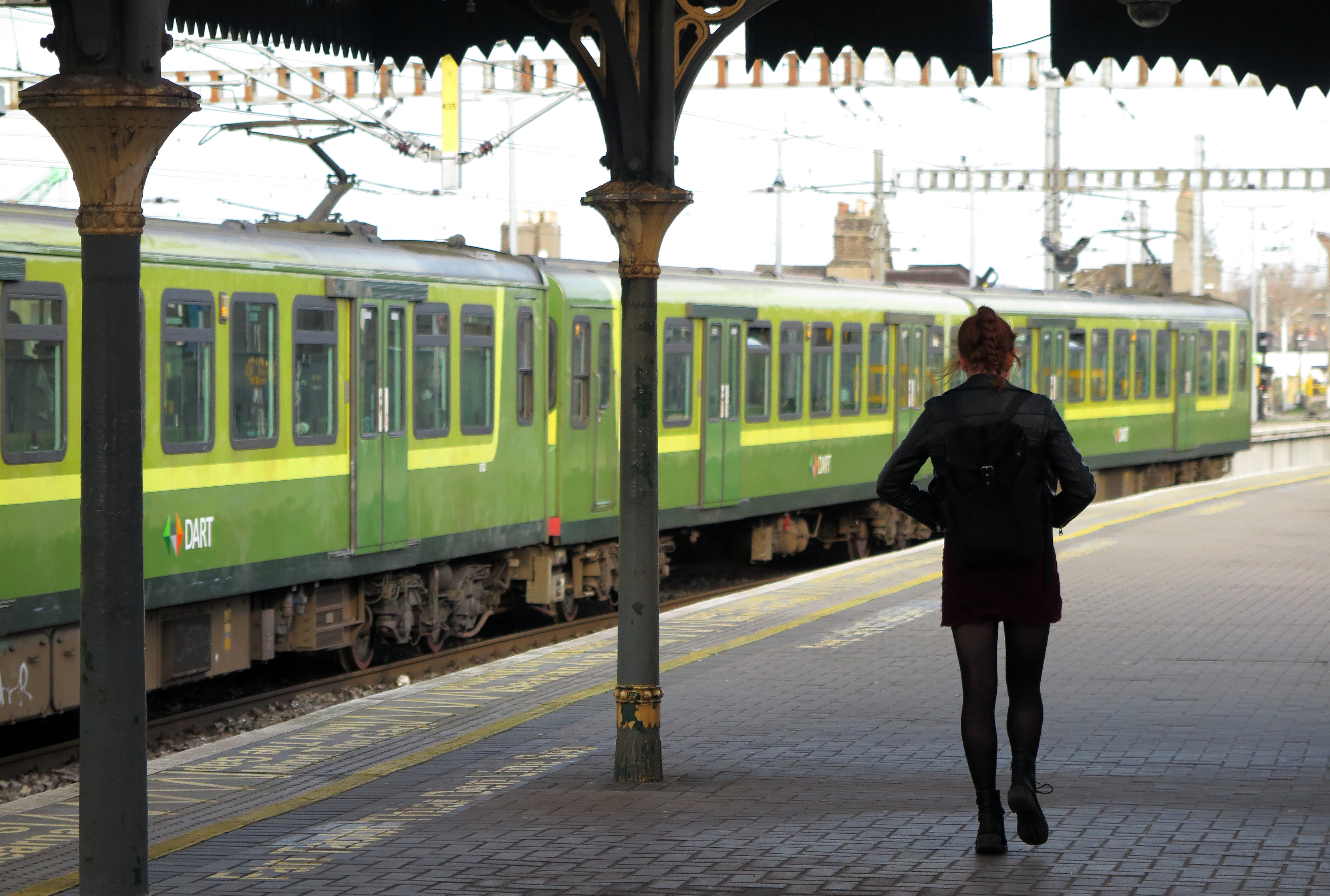
I was amazed that the clerk had believed the computer instead of me—as if I was likely to be sending a carefully-wrapped parcel to an imaginary island. And then I remembered that I too had recently fallen into the trap of blindly believing what technology was telling me. I’d been planning a week’s holiday in Ireland and the basic outline of the trip was to spend time in Belfast, Dublin and Galway. We were flying to Belfast and home from Dublin—that bit was straightforward. But when I consulted Google Maps to work out how to travel between the different cities, the only options that came up were buses and coaches. “I guess there are no trains in Ireland,” I thought and when I told Mike he didn’t disagree. Fortunately, before I booked all of our various coach journeys, a train-geek friend asked about our plans. It’s always nice when people show an interest. “We’re travelling around by coach,” I said. “There aren’t any trains in Ireland.” “Don’t be ridiculous,” he said. There’s a wonderful train system. I used it last year.” And he was right. It was wonderful. 

Photo: Richard Gatward

It’s hard to know what to believe when information comes at us from countless different sources. And the news is particularly tricky. These days I find it overwhelming because many of the issues are so complex that I simply don’t know what to think. I’m confident in my beliefs that recent UK governments have been incompetent, that Trump is despicable, global warming is real, Hamas is a terrorist organisation, and the level of civilian suffering in Gaza is terrible. But in so many matters it’s difficult to unravel exactly what is right and what is not. As Jonathan Freedland said recently, the people affected by the Israel-Gaza Conflict have suffered decades of pain. It’s not like a football match where you can support either one side or the other. It’s dreadful for people on both sides. And to something more trivial—are Harry and Meghan petulant attention-seekers or misunderstood game-changers. The only answer I can give is “I haven’t got a clue. How could I possibly know what things are really like for them?”   

I no longer watch the news on TV. And I’ve heard many people say the same. But I don’t want to shut my eyes to what is happening in the world, and so for the past couple of months I’ve been getting my news from The Week. I have a subscription and it arrives in the post every Friday. At some point in the weekend I try to sit down and read it pretty much cover to cover. What I like is that it doesn’t take an angle. Instead it gives a summary of how a range of different publications across the political spectrum, have reported news stories. It doesn’t necessarily help me make up my mind but it does at least improve my understanding of the issues and nudges me away from polarised conclusions. And in addition to UK, European and World news it has science news; business news; sports news; obituaries; book, film, theatre and art reviews; TV recommendations; a cartoon; a recipe, and even a weekly update on The Archers.  

It’s a small thing but it’s helping to keep me steady at the moment when so many of us are feeling small and impotent in a troubled world. I was talking about that with a friend this week. She has family in Israel and is extremely distressed about the conflict. “I feel so powerless,” she said. “I’ve thought hard about how to help and there’s nothing I can do to change the situation. The one thing…the only thing…I can do is to concentrate on being the nicest person I can be. That makes a difference to the people around me. It’s something I can believe in. So that’s what I’m doing.”

I’ll end on that thought and send greetings to one and all—wherever you are but especially if you’re on the Isle of Man or travelling on an Irish train this holiday season. Happy Christmas and a peaceful New Year. 

Belfast Big Fish by Mike Poppleton