A Mixed Diet

Elizabeth_David_gravestone

Photo: Guillaume Tell

Earlier this week I spent half an hour trudging through my online supermarket order and thinking about the advice on eating a varied diet. As I dutifully included a multi-coloured assortment of fruit and vegetables, protein and so on, I wondered, not for the first time, why human food has to be so complicated and take up so much time. There’s the shopping, the planning, the cooking, the serving, clearing up the spills, cleaning the fridge—it seems a great deal of effort. After all, cats seem quite happy with cat food, cows eat grass, and reindeer warble flies survive perfectly well on reindeer tissue.

cow grass

Indeed, not only do most animals have a narrow diet, but a varied one can be positively harmful. During the Second World War it was difficult to source the right food for zoo animals and the sea lions in Manchester’s Belle Vue Zoo were fed strips of beef soaked in cod liver oil. They were unable to digest this unaccustomed food and died of stomach ulcers. But the opposite applies to humans as too much of one thing is clearly not good. I recently discovered some rather nice apricot biscuits. The first was delicious. The second was pleasant, if a bit greedy. The third made me feel thoroughly sick and now I never want to see an apricot biscuit again.

sea lion

And so, back to the subject of food shopping which can be so repetitive and tedious. I regularly get stuck in a rut with day-to-day catering and wish I could just order a hundredweight of hay to get my family through the week. That way there would be no decisions to be made. But I do enjoy cooking for special meals and celebrations and I suppose that if I had a family of elephants then I’d miss out on all of that.hay

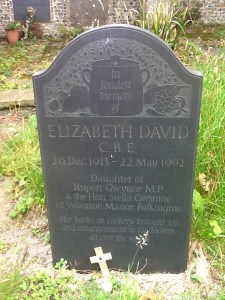
If I missed out on all of that then I’d also have missed out on a recent food-related treat. I’ve known for some time that the food writer, Elizabeth David is credited with transforming British attitudes to eating after the Second World War, but I was curious to find out more. So when I wrote my list of sixty treats she got a mention. ‘Cook three recipes from each chapter of an Elizabeth David book’ seemed a good way to explore her influence and ideas.

Things change, though, and since making the list five years ago, I’ve given up eating meat. I decided to forgo the pleasures of her classic books ‘French Country Cooking’ and ‘Italian Food’ in case they instructed me to pluck a pigeon, jug a wild hare or boil, breadcrumb and grill a pig’s trotter.  Instead I chose to focus my interest on ‘Elizabeth David on Vegetables’. This is a compilation of vegetable recipes and food writing taken from a number of her books. It includes chapters on soup, pasta, main courses, and small vegetable dishes, as well as the unexpected inclusion of chapters on bread and puddings.elizabeth david on vegetables
Her first volume, A Book of Mediterranean Food, was published in 1950. She wrote of sun-drenched, honest, peasant dishes which must have seemed so vibrant to a country that was still under the grey thumb of post-war rationing. Wartime recipe books included instructions on crow boiled in suet and how to create a pie from sparrows, whilst marzipan had become a ‘delicacy’ concocted from mashed haricot beans and a splash of almond essence. It’s hard to imagine a week in which I don’t use olive oil, aubergines, avocado, courgette, garlic, yogurt or basil but when Elizabeth David first started writing, these ingredients were largely unavailable. It was partly thanks to her influence, that they appeared in the shops. She died in 1992 and one obituarist observed that she had done more to change British middle-class life, than any poet, dramatist or novelist of the time.aubergine

So, as the treat progressed I selected and cooked my way through twenty-four recipes, and with her impeccable reputation I expected to be roundly wowed. But I was surprised. There were only two that I thought outstanding. These were truly wonderful, though, and I’ve already returned to them again and again. One is her mushroom risotto which is absolutely perfect. I’ve struggled in the past to get enough flavour into a risotto but this manages it with a simple and cheap list of ingredients: olive oil, stock, mushrooms, onion, Italian rice and garlic. It works every time and is creamy, comforting and easy. The other big discovery from the book is her sweet pepper and watercress salad. Again, simple with just a shallot, half a bunch of watercress and a fleshy red pepper. It’s lightly dressed with lemon juice, olive oil, salt and a pinch of sugar, but the revelation is that the shallot is sliced paper-thin and the red pepper is cut into matchstick strips. The end result is beautifully balanced and so much more elegant than my usual sling-it-all-in affair.

tomatoes and garlic

There was also a fresh tomato pasta sauce; a gratin made from grated courgettes; a Normandy apple tart sprinkled towards the end of its oven-time with buttery apple juices and a little sugar, and a cold dish of mushrooms cooked with coriander seeds. All were good and I’ll probably make them again. But I was disappointed with the other dishes. The orange ice cream was horrid and the green vegetable risotto was dull. Maybe some tastes change over time.

I’m not completely won over but I am glad to have made her acquaintance, and like so many of these treats, this one has changed me. I find myself opting more for straightforward good-quality ingredients and letting them stand alone, when I once would have reached unthinkingly for a stock cube or a splash of instant flavouring. My interest in cooking has been invigorated once more—and with that good news, my family is saved from hay, hay and hay for a little longer.

elephant baby

A Coastal Jigsaw

kayaks

The honeymoon is over. It was a glorious week on Guernsey where we cycled, swam, and did a bit of sea kayaking. I’d like to sound brave and sporty about that last one, but when the wind pushed me sideways, I confess that I panicked. My imagination ran riot for a few dramatic seconds as I fantasised about being swept off to the Pacific and spending years on a desert island. That seemed tragic as I’d only just got married but luckily I was rescued by the group leader, Skip. He was young and competent and didn’t make me feel hopeless as he tethered my kayak to his, and towed me through the tricky bits.

honeymoon

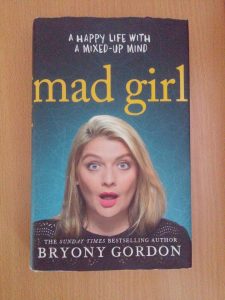
Guernsey is beautiful and one of the best moments was when we stood high above a tiny bay late at night. The Channel stretched  beyond and the full moon was reflected in rippling, golden stripes–a true honey moon. Another holiday pleasure was having time to read. I still struggle with fiction (see Parkus Interruptus), but thankfully I do now enjoy non-fiction and one of the books I took with me was Bryony Gordon’s ‘Mad Girl’. A journalist with a glossy career, loving husband and baby daughter, she seems to have everything. But she’s remarkably candid about the obsessive compulsive disorder and rigid thoughts that have troubled her for years. At one stage she found it easier to take the iron to work rather than having to go back and check a dozen times that she’d switched it off. It made me reflect on my own behaviour which veers towards rigidity at times.

mad girl

When we got home, there was still a bit of holiday left so we decided to spend three days walking the South West Coastal Footpath in Dorset. This is probably the most challenging treat on my list. The act of writing it down was simple enough but at times I’ve wondered whether I’ve bitten off more than I can chew. It’s 630 miles long and as each section gets further away from home it becomes more of a time-consuming and costly obstacle. There’s a list on my study wall that breaks it down into fifty-two stages and so far, only eight stages have been crossed off with my pink highlighter pen. I’ve started to wonder whether this treat will fail to reach crossed-off Nirvana by the time I have my next big birthday. That’s only two and a half years away. Help.

The only way I know how to tackle a challenge is to try to tame it and impose some order. However, this treat is presenting particular challenges and I’ve already had to hold my nose and make a major tweak to my method. When I started five years ago, I was intending to walk anti-clockwise from Minehead to the Dorset coast near Poole. I got as far as Barnstaple. Then when my marriage ended I abandoned the walk for several years. When I restarted, I was living in another part of the country and it made logistical sense to resume at the Poole end and to walk clockwise in stages until I got back to Barnstaple. It felt like a daring break with the natural order but I justified it to myself as a symbol of a new and different life salvaged from the chaos.

swcf9

Then, last week when we were planning this second half of our honeymoon a radical thought planted itself in my head. I realised that it might be sensible to postpone a few stages. These were close enough to home to be done as day trips and staying away for two nights would give us an opportunity to do others that were further away.  I hyperventilated and struggled. Once again, chaos seemed to be threatening my nice ordered list.

In the end I managed to overcome my discomfort and we had three memorable days of walking. Each was different and brought unexpected pleasures. We spent much of the first day walking alongside the Fleet Lagoon that runs beside Chesil Beach. Three cormorants sat motionless in a wooden rowing boat, mountains of pebbles rose up to our left and we saw only a handful of people.  The next day we trudged along the beach for miles. The pebbles made it hard work but once again it was unexpectedly deserted. Several times we walked close to great flocks of gulls that had gathered by the sea. As we approached they took off and gave us a private aerial display.

swcf5

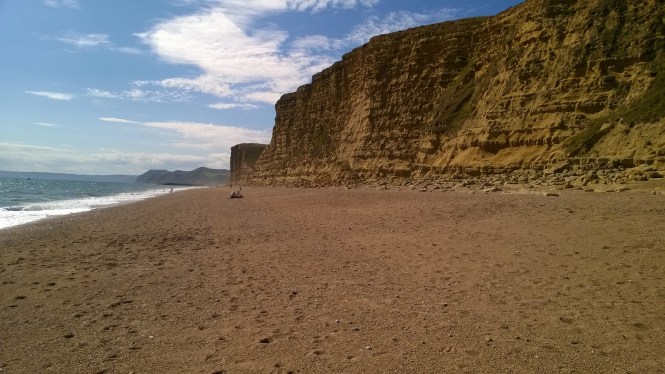
I enjoyed seeing the sea kale that has colonised the inhospitable shingle and as we approached West Bay, the cliff towered above us, steep and golden like an Egyptian sphinx. We swam and then we explored the small resort. I was expecting it to be staid and faded but instead we found ourselves eating wonderfully fresh fish at one of the coolest places I’ve ever been. Sins at the Bay is furnished in a salvage-gone-mad kind of way with red rusty metal rafters and techno music. I felt fully alive.

swcf 1

The third day was different again with lots of upsy-downsies. I puffed my way unhappily up the first one and realised that I needed a better strategy. Golden Cap, the highest point on the South Coast loomed as an after-lunch challenge so I tried a new approach: thirty steps then rest for five breaths, and so on. It worked and I reached the top having barely broken into a sweat. I also made some new friends on the way. A young couple were just behind on the uphill trudge, and when I told them about my new discovery they looked pleased. From then on, every time I paused, I looked back to see them standing still as they concentrated earnestly and puffed out their cheeks. It felt like an unusual kind of antenatal class.

And now that the honeymoon is over I find myself longing for the next opportunity to get back to the footpath. I’m hoping to do another two stages soon, and for logistical reasons it’s likely that one will be in a clockwise direction from our accommodation, and the other in an anticlockwise direction. I’ve managed not to hyperventilate too much at this impending disorder. A friend asked the other day, ‘So does this mean that if I invited you to join me in Falmouth, that you’d be prepared to do some stages out of order?’ I took a deep breath and said, ‘Yes’.

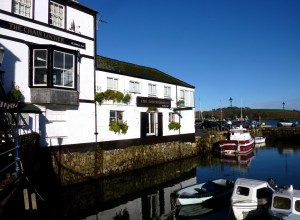
falmouth

The Sixty Treats project that led to my book 31 Treats and A Marriage started out so innocently. But it continues to teach me all sorts of surprising things. I realise that I’ve misled myself into thinking that the pleasure of this great walk lies in its ordered completeness. I’ve yet to find out whether I’ll finish the entire walk before my sixtieth birthday but I do know that it won’t be in any kind of order and that ultimately neither the completion nor the order matters. I want more of the great sweeping views but even more than that I want to uncover the small unexpected pleasures that make each day such a unique mini-treat. Maybe the honeymoon’s not over after all.

swcf7

An Exceptional Treat

Guernsey

These days I spend a lot of time in my head, playing with ideas. I used to think naively that writing was about sitting down and making the words flow but actually the most time-consuming part is working out how to solve various problems—what angle to take, how to structure the story, what to include, and crucially if you are not to bore your reader, what to leave out. This is all wonderfully absorbing but the downside is that with so much mental stimulation it’s easy to neglect the physical world.

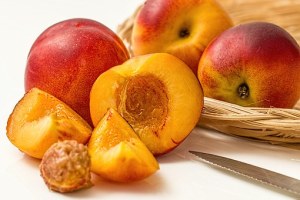
The first time I gave proper attention to this thought was about four years ago when I was in shreds at the end of my marriage. I had some sessions with a counsellor and during one of these she suggested I spend time focussing on the sensual side of life. And she was wise—moments of taking in the smell of the roses in the garden, the taste of a juicy nectarine, or the sound of birdsong in the park, brought brief relief. They provided some escape from the repetitive thoughts that went round and round in my head as I tried to make sense of what had happened and to adjust to it.

nectarine-1074997__340

When my marriage finally shuddered to an end in court I tested out my new, raw state of independence by having a day alone in London. I did something to stimulate each sense as a symbol of being alive and ready to face a different path. At the National Portrait Gallery I lingered amongst entries to the annual portrait competition. Some made me smile, others were poignant. Such a mix of lives ranging from two elderly women having their hair done, to an impoverished waitress in a South African township cafe. They stared out at me and I escaped briefly into many different worlds.

National_Portrait_Gallery

Photo: Jeremy Thompson

Then I walked to Paul A Young’s Soho chocolate shop. He pushes the boundaries with extraordinary flavour combinations…sea salted caramel with cigar leaves…raspberry and rose vodka…ginger pig black pudding, sourdough and rye whiskey…goats cheese, rosemary and lemon… The assistant offered me a sample. It was quite simply the best truffle I had ever tasted; dark and velvety with a hint of salt. I groaned Harry and Sally style, and she backed away nervously. Later, I sniffed 1930s perfumes whilst discovering some inter-war social history in one of Odette Toilette’s engaging talks. A swim at Marshall Street’s art-deco baths came next and I tried to concentrate on the cool water rushing over my bare arms and legs. It was welcome on a sultry city day. And to round it all off, I sat in a pew at St Martin-in-the-Fields whilst a passionate, long-haired violinist bowed Vivaldi, and reflections of candlelight cascaded in the windows. It was a perfectly distracting, perfectly rounded day to mark the start of my new life. But grieving is not easily cast aside and the next day I was frustrated to find myself crying in despair at the supermarket checkout.

Paul A Young

Photo: Tom Morris

There were reasons to be cheerful, though, and one in particular was a man I met for the first time under the clock at Waterloo. We’d been introduced via email by a thoughtful mutual friend and I was nervous at this first date in thirty years. I tried to stay cool and present myself as a woman of the world but within minutes I’d blown it. Instead of leading us confidently towards Waterloo Bridge and the lunch he’d booked, I led us confidently into a dustbin area round the back of the station.

Waterloo_Station_clock

Photo: Oxyman

Things progressed tentatively but positively and after a couple of birthdays together I gave him a present of a five senses day in London: a guided walk around Chelsea’s Arts and Crafts architecture; spectacular food at Borough Market; choosing a new aftershave at Jo Malone on Sloane Street (nutmeg and ginger); an indulgent afternoon at Ironmonger Row spa, and a balmy outdoor performance of Porgy and Bess in Regent’s Park.

The day was such a success that we had a return match for Christmas. This time with 1960s perfume in another of Odette Toilette’s social history talks—hippie patchouli, Kennedy, bachelor girls, and aspirational advertising. Then there was a giddy view of London from the top of the Shard, and later, cocktails at the Ice Bar. The walls are frozen and it’s so cold that they give you insulated cloaks to wear, and gloves to hold the chunks of ice that serve as glasses. We took in the sharp, hot, satisfying flavours of Peruvian food at Ceviche in Soho and then danced in Camden’s Jazz Café as Yolanda Brown played reggae-influenced jazz—a beautiful young woman in a short skirt, totally absorbed in playing her smoky saxophone. I knew my companion would enjoy that.

Yolanda_Brown_2

Photo: Richard Kaby

And now, several years later, I’m on holiday in Guernsey. Relaxing after a hectic few months and once again trying to make sure I notice at least some of what my senses feed me. There’s the crunch of the pale sands, the fruity sweetness of mango sorbet licked in the cone until my tongue is rough like a cat, the wide open island sunshine reflected from the water all around, the elusive scent of the hedgerow honeysuckle, and best of all—the feel of my new husband’s hand in mine.

wedding mike and lynn 1

Enough’s Enough

monkeys 2

I’ve had to talk firmly to myself over the past few weeks. Unfortunately, there are plenty of momentous distractions in the UK right now so I’m not concentrating terribly hard on what I’ve got to say. But I must find a way to listen. It’s important.

My problem is that I’ve unwittingly hopped onto a treadmill. And now that I’ve realised my mistake I need to figure out how to get off—it’s exhausting and can only end in tears.

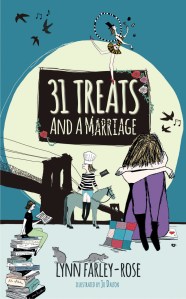
9780993471100

Since publishing my book, 31 Treats And A Marriage, it’s been gratifying to get positive feedback. Some people seem to have genuinely enjoyed it and I got a lovely write-up on the BBC Arts website.  At one point I was squeezed there between Benedict Cumberbatch and Kazuo Ishiguro—a pretty good place to be.

The trouble is that whilst that’s more than I could have hoped for, it’s a hungry beast to feed. The other day I spotted a good review on Amazon—the pleasure was momentary—then it was straight onto hoping for the next one. A book group told me that they were planning to read 31 Treats—and then there was another—it was all very pleasing but I couldn’t help wondering about the next one.

The drive to keep achieving more is one of the reasons we’re such a successful species. Monkeys don’t push themselves like this. But whilst it’s got plenty of benefits, it’s also a curse. Is the really successful person the one who ticks all the boxes and immediately creates a new set of goals? Or is it the one who finds every bit of success exciting and takes a lasting pleasure in each one for its own sake?

monkey

Shall I find a way to be happy that I’ve met one of my biggest ambitions by writing a book? Or shall I be dissatisfied because I’m never going to win the Pulitzer Prize? And even if I did win it, then the next wish would throw itself into the fray. I’d long for comparisons to Shakespeare—with him coming off worst, of course. A hedonistic treadmill, indeed.

And if I was to reach the absolute pinnacle of my ambitions? Where next?

I could slither down or jump off.

shakespeare

I did an interview recently with a young actor named Susan Wokoma and we talked about some of the problems of being creative. One, is that it’s hard to know when you’re a success. Out of a hundred people, ninety-five might like your work and five might hate it. But Susan has a calm confidence and talked about realising that her rewards don’t come from impressing people or showing off. What’s important is the intrinsic satisfaction of doing something that she loves.

My chat with her came at just the right time, when I was tussling with my treadmill. It made me realise that I, too, am doing something that I love. Sentences go round in my head all the time and elbow their way out—sometimes at the most inconvenient times. If I stopped writing then I wonder where these sentences would go. I imagine them rioting through the streets or worst of all, lying defeated and lifeless in the gutter before they’ve had the chance to draw breath. I couldn’t let that happen and so would have to write even if I had no audience whatsoever.

worcester

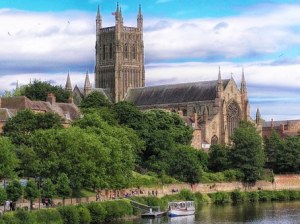
I’m working on my second book now and am becoming intimately acquainted with twelve great English cities. I’m finding out such a lot of interesting things. In Worcester I learned about secret industrial recipes; in Manchester I got to grips with some powerful political history, and far-flung Hull was saturated by the elements and its history of whaling and fishing. All of this was interlaced with the poetry of Philip Larkin. And most recently, in Leicester I set foot tentatively inside a huge white Hindu temple where I was welcomed and allowed to sit quietly and absorb the atmosphere. Every city has many sons of which it is proud, but I am focusing on just one daughter for each; twelve women who have challenged the prevailing constraints of their time. Who knows what might happen with all of this—and does it matter anyway? I need to step off the treadmill and just enjoy the process. After all, I’m busy saving those little sentences from an early demise in the gutter—I’m doing what I love.

manchester

One thing I’m particularly enjoying at the moment is the Chain Interview Project. I’m meeting fascinating people and mining all kinds of stories that I would never find otherwise. I recently interviewed Susan, a young actor. She told me about her work and what’s important to her. It’s an exciting time for her: she’s just started filming a big TV series and at the end of our interview she passed me on to someone who’s played a very important part in her life.

A Box of Memories

prius

I’ve had my car for eleven years, and yesterday I sold it. It’s a silver Toyota Prius and started out pristine like the one above. Since then it’s collected quite a lot of bashes and dents. A bit like me.

Molly, my youngest daughter, was seven when I bought it, and this week we were sitting in the car, when I told her that we wouldn’t have it much longer. I was surprised at her reaction. ‘Is it going to a new family?’ she whispered, with concern. When I shook my head she lowered her voice further and said, ‘It’s not going for es see ar a pee, is it?’ I said that I wasn’t sure, but it might be, and she patted it kindly.

mimi

I’m not sentimentally attached. It’s a car and all I want it to do is to start when I put the key in, and to keep me and my loved ones safe. It’s never once let me down but a recent service showed that there are several expensive problems looming so I decided that the time had come to part company. It’s done many miles and I’ve bumped into a lot of obstacles so I knew that it wasn’t worth very much.  I made an appointment and drove it to a supermarket car park on the other side of town. There, I parked next to a PortaKabin and got out for the last time. On first sight the webuyanycar.com representative, Leo, seemed bluff and brisk but as I sat down he looked at me and asked gently if I was upset. ‘People often are,’ he said. ‘You’d be surprised.’ ‘No,’ I said, ‘it’s OK. It’s just a car.’

I produced the log book, my driving licence and a recent utility bill. Then I sat patiently whilst the IT system went down and Leo made lots of phone calls and sighed. I was grateful for a quiet few minutes with nothing much to do.

IT

It’s always astonished me that I’ve managed to accrue such a huge mileage on this car. I’ve used it for work commuting and also for what must amount to thousands of school runs. Even so, 216,000 miles seems a lot and my local mechanic obviously thinks so too as he calls it ‘the space shuttle’.  But recently a knowledgeable friend told me that he knows of several cars that have done 400,000 miles and some that have done a million. There’s even one Volvo in the US, that’s driven more than three million miles.

space shuttle

I’ve enjoyed having a hybrid car. For one thing, the road tax has been zero and for some years it was exempt from London’s Congestion Charge. And a particular quirk is its quiet engine. There’s almost nothing to hear when you start the ignition. This can be dangerous for pedestrians and on one drive to school through Kentish country lanes, we came up behind a very elderly gentleman walking down the middle of the road with his dog. For several minutes I crept along at walking pace, with Molly and her friend squealing with delight. It seemed rude to hoot and I was worried about frightening him but eventually I had to do something, so pressed the horn as lightly as I could. He whipped round, threw himself into the hedge and we passed silently on our way.

180px-'99-'01_Land_Rover_Discovery

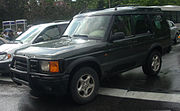
I don’t mind driving a scruffy car. In fact it’s quite a stress reducer. Once you have a few scrapes then you can stop worrying about further damage. But I know that not everyone feels this way. I fell foul of this some years ago when I borrowed my then-husband’s precious Land Rover Discovery and used it to take some rubbish to the tip. As we arrived I was chatting to my youngest son and imagined that I was in my own normal-height car. However, I soon remembered that I wasn’t, when the high-sided Land Rover got wedged under the height barrier. It hung there unhappily and the roof looked as though it had been attacked with a large can-opener. Several staff appeared and walked around with pursed lips. ‘He’s not going to like that,’ said one. Then they helped me unhook it and I drove it home. I knew that ‘he’ wasn’t going to like it so I took a deep breath and tried to soften the blow. ‘I’ve got something to tell you’, I said. ‘I haven’t been having an affair, or beating the children or shoplifting or fiddling my tax, but I have had a little accident in your car’. I’d never seen him so furious. He could barely talk to me for days. Sometimes I wonder whether this marked the start of our terminal decline into divorce.cross manMy car has seen me through an exhausting succession of stages. Whilst I’ve had it, I’ve been married, separated, divorced and now engaged again. It’s taken me and my children on many trips up and down the country for university, holidays, and treats. It’s been there whilst I’ve laughed, chatted, listened to Radio 4, explored new music, sworn in frustration at the M25, and rubbed my sore feet at the end of many a long walk. For several years it was also there whilst I cried and raged in despair. And when Molly and I moved a hundred miles to start a new life, it carried us and our belongings.
Eventually, Leo stopped huffing and puffing and announced that the IT was now working. He took his clipboard and walked slowly round the car noting down three pages-worth of dents and scrapes. We did a bit of negotiating on the price and then he scanned my documents. It was very simple. Even though I profess to be unsentimental about objects, I found myself asking, ‘What will happen to her?’ ‘Someone from British Car Auctions will come and collect it,’ he said. I hardened my heart. It’s just a car.

But as I went out, I couldn’t help but lean over and give her a surreptitious little pat and a ‘thank you’ slipped out. It’s about the memories. We’ve been through a lot together. Now it’s time to move on.treasure

Remains of the Hay

barack-obama-and-his-dog-bo-1174375__340

Last week I went shopping with my daughter, Emma, and as always she gave me something new to think about. She works in business development and has recently been exploring wearable technology. One particular growth area is lifelogging when people capture every aspect of their life by continuous video recording using a camera in their clothing, on their glasses or round their neck. One of the issues with lifelogging, though, must surely be in identifying what’s noteworthy in amongst the daily round of cleaning the loo, munching toast and snoring.

hay 2

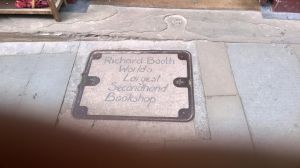
As it happens this week has had less loo cleaning than normal as I’ve been at the Hay Festival. It was my first visit and turned out to be a real treat. Hay-on-Wye is an astonishing small town just inside Wales with thirty second-hand bookshops and a population of about 1,500. The Festival of Literature & Arts was devised around a kitchen table in 1988 and was said to have been funded from the winnings of a game of poker. Today, it’s a world-class festival of ideas, with international offshoots; you can if you want go to Hay Festivals in Mexico, Spain, Peru, Ireland and Colombia. Bill Clinton spoke at the 2008 Festival and called it ‘Woodstock for the Mind.’

hay 3

I often feel frustrated that most of life leaves such faint traces in my memory. It’s back to that old idea that if you don’t have reminders then there’s no proof that you were there. And this week there was much that I would like to have held onto. As usual, though, I was distracted by random thoughts that jostled in sideways, and so in the absence of lifelogging technology I shall have to rely on a disparate collection of the bits that did stick. With hundreds of events taking place over ten days, everyone there will come away with a different set of impressions. Here are some of mine.

I could have listened to Bridget Kendall, the BBC’s Diplomatic correspondent for hours. She was fascinating on the subject of Russia and described the occasions when she’s met Vladimir Putin. In 2001 he’d been president for just a year and she talked of meeting two Mr Putins. There was the public one, and the personal one who was less certain of himself. When asked who wore the trousers in his household he laughed and said it was his wife. Five years later, the Russian economy had grown and he was stronger and different. Now there was just one Mr Putin. The one with steely-blue eyes who tried to score points off the foreign journalists.

putin

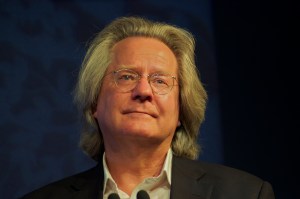
Then there was the philosopher AC Grayling, who spoke softly and intimately as if he was telling us a bedtime story. His account of the changes in thinking brought about by the Thirty Years War was illuminating but it was a small nugget about Newton that stuck with me. Everyone knows about gravity, the apple, and calculus, but I’d not known that he spent a great deal of time looking for hidden messages in the Bible. He believed that if he could only crack its numerological code then he would discover a blueprint for the universe.

AC_Grayling

AC Grayling: photo by Ian Scott

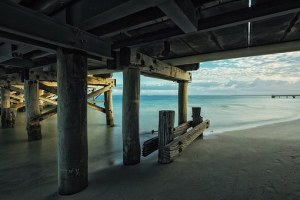
Joan Bakewell talked about what it’s like to grow old and it was very hard to believe that she is now 83. There was lots there of substance, politically and personally, but I liked what she said about her pastimes. All her life she has collected postcards from galleries around the world. She keeps them in shoeboxes and often these days she thinks to herself, ‘I’ll have an afternoon with my postcards.” She takes them out and looks at them closely. Each time she sees something new. She’s also patron of the National Piers Society and enthused about the contrast between the upperside which is all jollity and the underside which is sinister and eerie with its barnacles and detritus.

pier

On Monday afternoon, Danny Dorling, an Oxford professor of social geography talked about analysing the three most recent censuses up to 2011. There was a huge amount of data there but I was struck by an unexpected trend. Everyone thinks that life expectancy in the UK is increasing but when you look closely then it’s not so straightforward. Immigrant populations are living longer overall and boosting the figures but there’s been a big increase in people dying in their late 70s or early 80s and these are mostly middle-class women. The life expectancy of this group seems to be falling, and Professor Dorling speculated about the role of austerity in this. Meals on Wheels have been abolished, and there have been significant cuts to rural bus timetables and healthcare services.

The comedian Susan Calman talked about her ‘crab of hate’ depression and managed to make it both moving and humorous. Earlier, I’d listened and watched as Benedict Cumberbatch, Maxine Peake, Olivia Colman and friends read out a diverse collection of letters and I’d also passed Germaine Greer in the street and recognised her indomitable voice before I saw her face. On Monday evening, the award-winning documentary maker, Norma Percy chatted about the making of her recent series, Inside Obama’s White House. She described Obama as ‘the coolest guy in the world’, and was granted an interview with him. Unfortunately she missed it as she got mown down by a bicycle whilst walking towards the taxi that was due to take her to Heathrow. In the ambulance the paramedics said conversationally to this unassuming grey-haired older lady, ‘And what were you planning to do today, love?’ Her reply that she was going to the White House to interview Obama only served to increase their concern about her level of brain injury.

Norma_Percy_2013

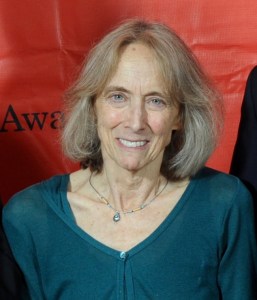
Norma Percy: photo by Peabody Awards

But the highlight for me was a session on punctuation by the linguist and broadcaster, David Crystal. It might not sound the most gripping of subjects but in the hands of a master speaker it became fascinating, and the audience of 1,700 was rapt. He set out to write a book about the usage and history of punctuation marks in the English language and expected it to be about 150 pages. The rules are so complex and inconsistent, though, that it ended up at more than double that length. And no punctuation mark attracts more inconsistency than the apostrophe. You have only to look at London underground stations to get a taste of this. There’s King’s Cross, then Earls Court with Baron’s Court right next to it. Harrods and Claridges should by rights be Harrod’s and Claridge’s, and Waterstone’s recently transmogrified into Waterstones causing massive annoyance to pedants.

Later, I went to another excellent talk by David Crystal. This time it was about eloquence. He analysed some of the great speeches including Obama’s ‘Yes We Can’ victory address. And I learned that the concentration of listeners wanes briefly every five minutes or so. Perhaps my random jostling thoughts are quite normal after all. Wise speakers anticipate this pattern and give their audience regular breaks; they might pause for a sip of water, or just stay silent for a moment.

I was at the Festival from Sunday to Wednesday and it was a wrench to leave. Had I stayed till the end I might have seen Michael Palin, Simon Callow, Fay Weldon, KT Tunstall, Jeanette Winterson and any number of other less famous people with interesting things to say. What I have done, though, is to book accommodation for next year. Who knows—if I keep going then I might one day see Obama there. Like Norma Percy, I too think he’s the coolest guy in the world.

obama

Stage Post

Tom_Hanks

Photo: Angela George

Last week I heard one of my favourite actors almost lose his composure. Tom Hanks was the castaway on Desert Island Discs and talked about the impact that theatre had on him as a teenager. By the age of thirteen, he’d already had a mother and two stepmothers, and had lived in ten houses in five cities. Life was unsettled but he started going alone to the American Conservatory Theatre in San Francisco and there he discovered a new world. He saw ‘plays he never even knew existed,’ and when he talked of it giving him a ‘vocabulary for loneliness,‘ he was audibly moved. In these situations radio feels very intimate. As listeners, we heard him gulp and swallow and we waited as Kirsty Young gave him a moment to recover.

theatre curtains

I could relate to that in my own way, as I, too, learned to love theatre as a teenager. Growing up in a sleepy Devon town where nothing happened I was hungry to move to London. Once there, I stretched my wings and explored what the city had to offer. Museums, galleries, cinemas, dance, and music were shiny, but for me, theatre was the jewel in London’s creative riches. I could breathe the same air as accomplished actors, famous or not, whilst knowing that the performance I’d seen was unique and ephemeral. It can’t always be good, but theatre was then, and still is, a favourite treat. A prospect to relish during a busy day, before you slide into your seat in the dark, and let it take you over.

Many plays are just confections but others have the potential to disrupt society and at times their performance has been tightly controlled. The Puritans under Oliver Cromwell banned staged plays because they feared civil unrest. Then after the Restoration, theatrical performances started up again, often in converted tennis courts. But they were quickly brought under control so that ‘the spoken word for gain’ could only be performed in a theatre that had been granted a royal patent. Initially there were just two; one in Drury Lane, the other in Lincoln’s Inn Fields and then gradually through the eighteenth century others were created. These were the Theatres Royal and several still continue today including the Theatre Royal, Haymarket and the Theatre Royal, Bath. Right up until 1843 it was illegal to perform a serious play unless it was in one of these theatres. Anything with music, however, could be freely performed and this helped to boost the popularity of opera, pantomime, music hall, and plays with musical interludes.

theatre royal

In 1809, a theatre itself was at the centre of unrest. The management of the licensed Covent Garden theatre, raised the prices and created boxes that could be rented. There was outrage amongst the theatre-going public and during a performance of Macbeth the audience began to riot. These riots continued for 67 nights. The theatre was filled with banners and it was difficult to hear what the actors were saying. At one point the management brought in a famous boxer and his associates in order to try to contain the mayhem but it just made things worse. These Old Price rioters, as they called themselves, ranged across the social groups and saw the price rise as a suppression of their liberty. Kemble the theatre manager was forced to lower the prices again and to issue an apology.

Today, theatre continues to explore new territory. I wrote in a previous post (A Postmodern Mystery) about the wondrous Punchdrunk with its immersive productions. Another intriguing company is You Me Bum Bum Train. I’m on their mailing list but the tickets are allocated by lottery and I haven’t yet been lucky.  Anyone who does get to go to one of their pop-up performances in an unusual London location, is sworn to secrecy. A Time Out reviewer said, ‘Part of the terror and joy of it is not knowing what might be on the other side of the many, very different doors…it’s also sort of a game and sort of like nothing else on earth.’ I’ll carry on applying.

surgeon-1049535__340

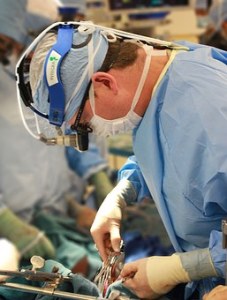
London theatre is a big draw for tourists and some Australian friends had an odd experience a few years ago. They’d heard that Judi Dench was playing in ‘Peter and Alice’ at the Noel Coward Theatre and that a small number of returns tickets were available every evening. They joined the queue, only to get right to the front and be told that they’d missed their chance for that day. Suddenly, a man dashed out of the theatre in evening dress. He thrust two top-price tickets into their hands and said, ‘It’s your lucky night,’ as he dashed into the night. They thoroughly enjoyed their treat and spent the interval speculating about who their mysterious benefactor was, and why he’d not been able to use his tickets. Their favourite theory was that he was an eminent surgeon and had just been called away to do a life-saving operation.

globe theatre

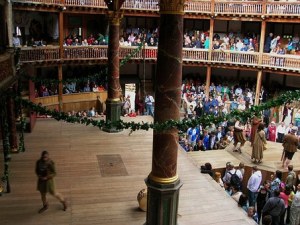
I’ve been keen to share my love of theatre with my children. It’s clearly worked with my elder daughter, Emma, as one of her current treats is to see all of Shakespeare’s plays. So far she’s seen quite a few at the Globe Theatre, including a gory production of Titus Andronicus that caused over a hundred people to faint. But I misjudged the situation with Molly, my younger daughter and started too early. When she was seven, Emma and I decided to take her to see ‘Anything Goes’ in London. We told her that it was a special treat and that she’d love it. She agreed happily but this was probably because she adores clothes and it was a rare chance to wear her smart hand-me-down coat. To anyone seeing us on the train that evening she looked the perfect theatre-going, middle-class wunderkind. However, she didn’t want to play ball. The performance started and within ten minutes she’d decided that she didn’t like it. She sat with her back to the stage and spent the next few hours with her arms crossed and a stony expression. Later, on the train we laid her down on a seat and she went straight to sleep, snoring loudly. People peered across to see where the noise was coming from and instead of seeing the corpulent banker they presumably expected, there was just a very small girl in her best coat; tired out after a rebellious evening at the theatre.

theatre-91882__340

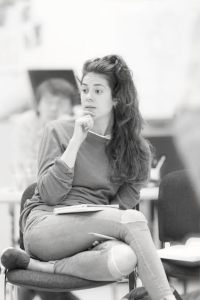
And here’s a theatre-related bonus. I recently met the fourth link in my chain interview experiment. Holly is a young theatre director and is currently associate director on the National Theatre’s award-winning production of People, Places and Things. I learned what her work involves and she told me about the things that inspire her. We talked about her successes and also about a recent challenging experience.

holly 3

System Overload

system overload 3

I like my neighbourhood very much but one of the disadvantages of living in a terrace is that it’s rarely possible to park outside our house. We often have to resort to the next street and sometimes this causes problems. Fortunately, our neighbours have dogs and regularly walk to and from the park. They’re impressively observant as several times they’ve spotted Mike or me wandering along vacantly trying to locate our cars, and have pointed us in the right direction.

This week, though, there have been many things to occupy my mind other than parking spaces. The most important of these is that Frank is in hospital. I’ve written before (in The Old Man and the Pea), about this rather wonderful 96-year old gentleman who last summer came to live with us. Five weeks ago he was admitted to hospital with stomach pains and then he got pneumonia. It’s very upsetting for him as he’s almost blind and matters are not improved by the fact that his hearing aid has disappeared. We think it got caught up in his bedding. His beloved talking watch has also gone. It probably went down the same laundry-oriented route. However, he does press the button every five minutes so we can’t discount the possibility that a fellow patient got fed up with the continual updates and disposed of it for him.  We’ve bought a replacement that he can use at home but for now, he is without it.

hospital 1

It’s hard seeing him in hospital as he is so disoriented. The other day I went in just as two nurses were changing him, and he looked so small lying there. I felt compelled to tell them that this frail, confused man once took an engineering maths exam and got the highest result in the whole of South Africa. My comment was no criticism of the staff, incidentally, as it’s been heartening to see the kindness and respect that they show to patients even when dealing with challenging behaviour.

maths

We hope to get Frank home soon but his care needs have increased and we’ve had a number of conversations with the occupational therapy team about new equipment. He needs a pressure-relieving mattress, a special cushion for his chair, a frame to go round the toilet and an alarm to warn us if he gets up at night. There’s a lot to consider.

Something else to think about is our forthcoming move. This should be happening in about three months after the new house is  renovated. Currently it’s a building site. We’ve cleared the overstuffed loft, disposed of the old appliances, and had many, many trips to the tip and charity shop. Now we’re into the stage of constant questions from the builders. It’s exciting but there are so many decisions to make: kitchen units; bannister rails; door handles; sinks; windows, paint—my head feels full.

construction

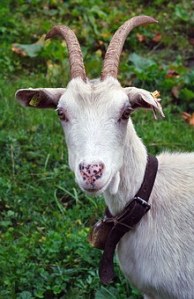
The other big thing that has preoccupied me this week is the birth of 31 Treats And A Marriage; my first book. It was published on Tuesday and is something I’ve been working towards for over four years. That morning my editor emailed and reminded me that I should post something on Facebook. But because of this ‘full head’ problem I couldn’t think what to say. I couldn’t even remember how to put up a post. Then after a bowl of porridge and a strong coffee, I got some perspective. An elderly gentleman, a house that’s a building site, and a book launch are a lot less demanding than previous bouts of juggling. The most challenging memories are those when I had four children at four different schools, a stressed-out commuting husband, an acre of out-of-control garden, and a pair of goats who spent every spare moment plotting their escape. These are all in the book together with plenty of things that made me laugh, and plenty more that didn’t.

goat

Eventually I managed to post something. The day improved as the book crept up the ratings and by the evening it was number one in its category on Amazon. Suddenly it all seemed very real. Then Amazon went into its own kind of system overload. It uses a complicated algorithm to work out how much stock to keep and when demand exceeds this then it puts up a message that says ‘temporarily unavailable’. If you were thinking of ordering a copy then please don’t let this put you off. It should get resolved quite quickly anyway, but will undoubtedly be helped by people placing orders. Click here for the link.

9780993471100

That evening after all the palaver, Mike took me out to a New Forest pub to celebrate. It was old with atmospheric woody corners and the air was full of a fishy deliciousness. We had a happy few hours and managed for the most part to keep off the subject of juggling. But as we got back, the day’s concerns sidled in again. We drove past our house and into the next road looking for somewhere to park. ‘I must have a good look for my car, tomorrow,’ said Mike. ‘I don’t know where it is.’ We both stared blankly into the darkness ahead.

Then I had a moment of clarity. ‘I know where your car is,’ I said. ‘We’re in it.’

Thank you to everyone who has sent such supportive and kind messages about the book. I hope you enjoy it. And I hope, too, that the system overloads for me, Mike and Amazon are quickly resolved. Winter2012

Murder, Blackmail and Other Stuff

Alfred_Hitchcock_cameo_(1943)_Shadow_of_a_Doubt_2

“Mum,” said Henry the other day, giving me an odd look, “Is everything alright?” “Yes fine,” I said, briskly. “Why?” “It’s just that I was in the kitchen and happened to look at your list. It said, Clean bathroom—Hang out washing—Buy anti-snoring device—Get fence mended—Murder!”

By the latter part of this week, I’d done all of those things and had a new list: Take parcels to post office—Contact dentist—Ring Barbara—Buy vitamin tablets—Blackmail.

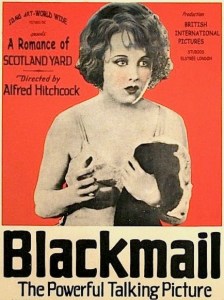
Blackmail

This week in amongst various other activities, I’ve completed Treat Number 41: watching Alfred Hitchcock’s films. A couple are lost but fifty-two have survived and I’ve now seen them all. There’s a wide range: from 1925 to 1976; silent to talkie; black and white to technicolour; horror to musical; British to American; outstanding to relatively forgettable, and Blackmail to Murder! The exclamation mark is Hitchcock’s not mine.

I watched most of these films on my own, often in moments when I should have been doing something else. They felt like stolen treasure. And as so often with treats, this one spread its wings beyond the original idea. I read Peter Ackroyd’s biography of Hitchcock, and went to the cinema to see the recent documentary about the Truffaut interviews. There’s the enjoyment, too, that comes from sharing the enthusiasm with friends. Alan, if you’re reading this, I look forward to continuing the conversation we started last year. I’m now better informed so will have more to say.

The-Wrong-Man-poster

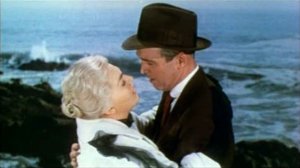
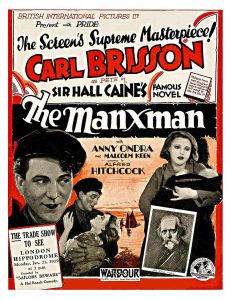
The highs and the lows? Those that made the least impact were Jamaica Inn, Secret Agent, The Paradine Case, Under Capricorn, Juno and the Paycock, and Family Plot. But there were plenty of pleasures amongst the rest. Favourites include The Lady Vanishes (the true star is a steam train which puffs its way through pre-Second World War Europe), The Wrong Man (based on the true story of a decent man who is wrongly convicted of armed robbery and is played impeccably by a dazed Henry Fonda), Shadow of a Doubt (a strong plot and possibly Hitchcock’s own favourite), The Manxman (a powerful silent film about a love triangle) and Sabotage (engaging scenes of pre-war London and a moment that leaves you reeling. Even Hitchcock wondered whether he’d gone too far). But it’s Vertigo that I love best. I went to see it at our local Picturehouse cinema recently and the images, music and plot haunted me for days afterwards.

Vertigo_1958_trailer_embrace

One of the intriguing things about Hitchcock is that he didn’t always provide audiences with feel-good endings. Some of his films have shocking final scenes. Another is his use of suspense. Psycho and The Birds make audiences scream, but in many of his works the hooks are more subtle. In the silent film Easy Virtue, adapted from a Noel Coward play, there’s a scene where the audience knows that a man is phoning his girlfriend in order to propose. Hitchcock chose not to show these characters at this point, but instead filmed a telephonist who listens in on the phone call. Her expression reveals what’s happening and builds suspense while both she and the man wait for the girlfriend to make her mind up.

800px-The_manxman

Like most creative geniuses, Hitchcock had some unusual habits. One of the oddest was that every day on set he would drink his tea and then throw the cup and saucer over his shoulder. He had complex attitudes towards his leading ladies and he almost certainly had crushes on a number of them including, famously, Tippi Hedren. But in spite of that he was devoted to his wife Alma Reville who was just one day younger than him. He trusted her judgement implicitly and she worked on many of his projects as a screenwriter and editor.  They got engaged after he proposed to her during a terrible storm at sea. She was prostrate with seasickness and told their daughter years later that ‘I was too sick to lift my head off the pillow. I groaned, nodded my head, and burped.’ They were married for fifty-three years and she was lost when he died, as he would have been had she gone first.

A number of themes crop up again and again in Hitchcock’s films: trains, dominant mothers, secret lives, likeable criminals, obsession, murder, and blonde women. He also loved dogs so if one of his characters owns a dog it’s a strong clue that they’re of sound character.

Alfred_Hitchcock_cameo_(1963)_The_Birds

And just like Hitchcock, all writers have themes that preoccupy them. Hemingway’s include fear, guilt, betrayal and loss. For Hardy, it’s the damage caused by social constraints, and the role of chance in people’s lives. And JK Rowling’s writing centres around themes of mortality and morality.

The_Birds_original_poster

Within the next fortnight, I shall become a published author too, so I’ve had a think about what my preoccupations might be. At the moment I’d say they are individual differences, coping and the unexpected twists and turns of life. Lists crop up a lot too. 31 Treats And A Marriage will be available through Amazon and other booksellers by the end of the first week in May. My previous post has a link to an audio recording of the prologue. If you’d like some more you can listen to Chapter One. Just click here. I do hope that you enjoy it.

The Politeness of Treats

daffodils

Last week I reached the end of a long walk. The North Downs Way stretches 153 miles from commuter-belt Surrey to the English Channel and I’ve been walking it in stages for over four years. Put like that, I seem a slow walker. But a lot has happened along the way. I’ve not only walked from Farnham to Dover; I’ve walked into a new life.

It was one of the first treats that I started, chosen because it was the nearest of the UK’s fifteen National Trails. I love the mystery of a long walk; you never quite know what’s going to unfold beyond that bend in the distance.  There are plenty of other pleasures, too: the landscape changes constantly; you have to watch out for the direction markers so it’s a bit like a puzzle, and it’s a perfect opportunity to think. Much of the North Downs Way coincides with the ancient Pilgrims’ Way: the route from Winchester to Thomas Becket’s shrine at Canterbury Cathedral. And at times, in the ancient broadleaf woodlands I felt so far removed from modern life that it would have been no surprise to bump into a silent, brown-robed monk.

forest path

I shared some stages with family and friends. These were chatty and companionable. But other stages were solitary and helped me to think my way round some tangled issues. Wordsworth is well-known as a contemplative walker and is estimated to have walked about 180,000 miles. In The Art of Walking, Christopher Morley says that ‘cross-country walks for the pure delight of rhythmically placing one foot before the other were rare before Wordsworth. I always think of him as one of the first to employ his legs as an instrument of philosophy.’ The South West Coastal Footpath is also on my list and providing my knees hold out, I’m hoping for some stunning days of walking around the very edges of Dorset, Devon and Cornwall. There’s much more to be said about walking, but this isn’t the point of today’s post, so I’ll save it for another day. Instead I want to think about the difference between treats and goals.

devon coast

When I made my list, all the stages of the North Downs Way were quite accessible as day trips. But then I moved to another part of the country and it became more of a challenge. I managed some stages last summer, and eventually, there was just the final stretch left. The excuses of the winter came and went and then I got an image in my head of walking through fields with Henry, my younger son, and the English Channel coming into sight. He was happy to join me but finding a day we could both do was the first hurdle, and we postponed several times. When the agreed day finally came, we set off from home at 7.30am and with dire traffic it was midday before we were at the starting point. It was all quite an effort and I began to feel that I was doing it because it was on a list and needed to be ticked off.

checklist

But later as I sat high on the headland with my son, I had a moment of clarity. The Spring sunshine scattered diamonds on the water; the chalky cliffs of Dover were to our left and the transport hub of Folkestone bustled to our right. We ate sandwiches made from Henry’s homemade bread, drank lukewarm coffee, and chatted easily. I realised in that moment exactly what it is about a treat that makes it so different from a goal.dover

Goals are in your face. They’re the kind of guys that spout management jargon and make you feel bad about yourself because you’re never quite up to scratch; qualifications—deadlines—efficiency—success. Goals are necessary to some extent, but they’re voracious feeders. Tick one off to keep it quiet and there’s another one screaming at you. Treats are quite different. They hang back politely in the shadows and defer to the goals. They wait to be granted permission to step forward, and often get neglected. Sometimes they’re just the germ of an idea or desire but give them a chance and they’ll blossom. They’re the things that allow us to express our individuality and to grow into our real selves.

I’ve got many memories from my day of walking with Henry. There was the moment when we stood high on the cliffs above Folkestone and looked down as a train disappeared into the earth at the start of the Channel Tunnel.  It was strangely thrilling to think that it would emerge in a different country. Another moment was realising, when stuck in traffic, that I had my son’s company and so the time was not wasted. And when we arrived in Dover we needed to make our way back to the car. ‘When’s the next train to Folkestone?’ I asked the ticket clerk at the station. ‘September or October,’ she said. We hadn’t heard that the line got swept away in the Christmas storms. So we got a bus instead.

bluebells

I’ve many impressions, too, of other stages of the walk. Dappled woodlands, quiet lanes, steep climbs, streams, lakes, brick viaducts, Neolithic burial chambers, sheep, bulls, thatched cottages, ugly developments, quarries, vineyards, fly tipping, primroses, bluebells, barns, chapels, the noise of the Medway Bridge traffic, cake, being elated, being sad…  On one of my walks I forgot to take any money. Solving that problem gave me confidence, as did walking alone. There were obvious pleasures and benefits but there were subtle, unexpected ones too. It was a multi-layered experience. And a true treat.

henry

Photo: Del Malcolm

A final word – it’s now less than a month until the publication of 31 Treats And A Marriage. You can have a taster if you want—click here for an audio file of the prologue. I hope you enjoy it and that you like the music too. It was specially composed and performed by Henry.